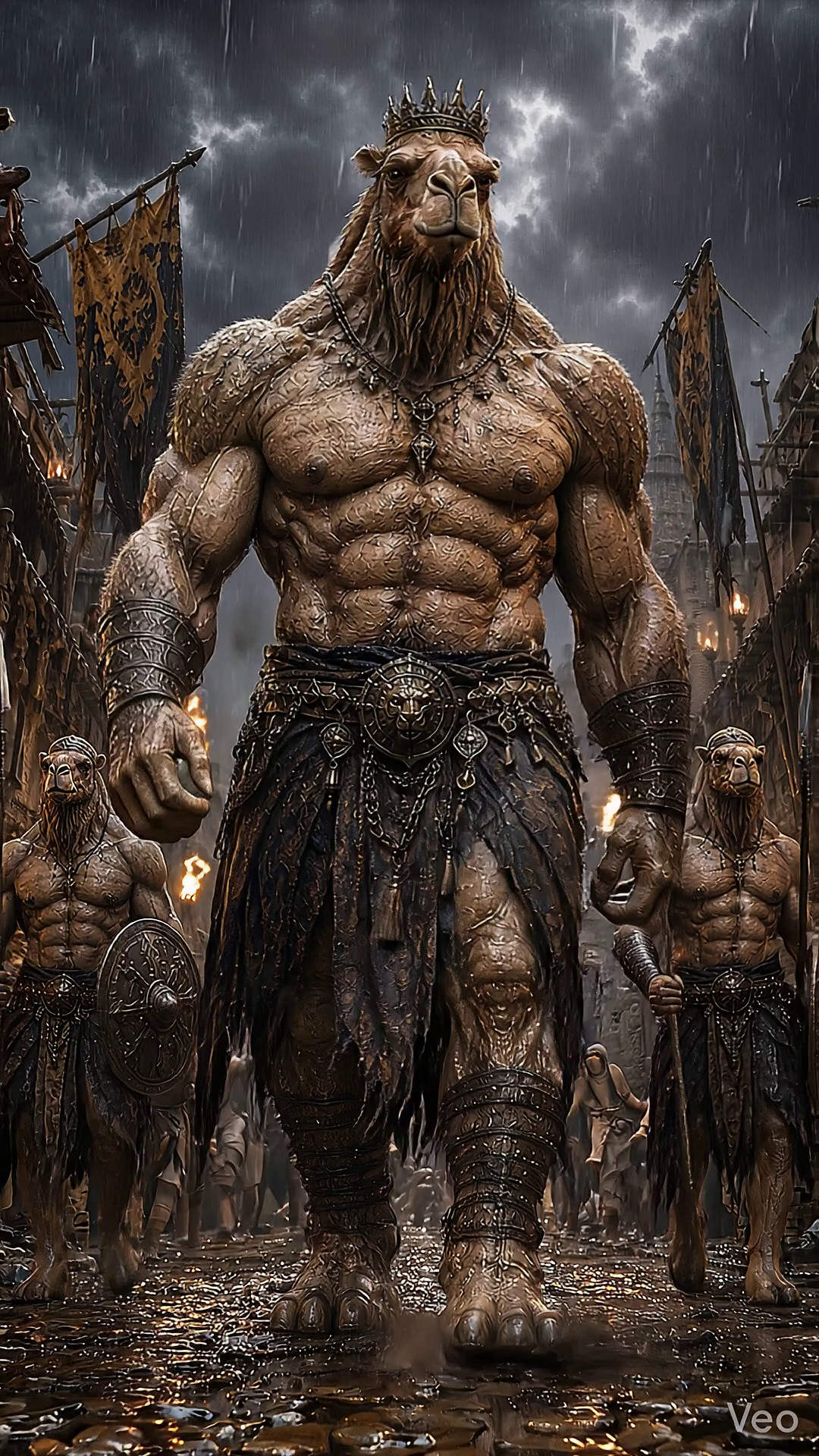
The Camel King enters the village. They expected a tired desert ruler. Instead, the road bent beneath a giant in bronze and dust. Behind him walked two silent guards of the same bloodline, smaller only because no one in the desert was built to stand beside him. He had crossed the salt wastes for one reason: a village had forgotten who owned the road. And desert kings do not come to remind people twice.
This chapter is presented as a complete written tale with curated scene artwork from the realm archive.
The village of Tamar Gate had been built around a road older than anyone's grandfather. The road came out of the white salt wastes, crossed the market square, passed the well, and vanished into the wheat country beyond the hills. Every merchant who reached it alive understood the same truth: the stones belonged to the Camel King, and so did the law that kept them from being swallowed by sand.
For years, Tamar Gate paid its tolls with grumbling obedience. A copper measure from each spice cart. A sack of dates from each caravan. Two jars of water from every wagon that used the protected wells. The elders hated the tax, but they loved the patrols that rode ahead of the caravans, loved the watchfires on the ridges, loved the way raiders turned away when they saw the bronze camel seal burned into a gatepost.
Then the drought came. The river behind the village sank into a chain of muddy pools. Goats died in the pens. Children began to look at market bread the way soldiers looked at a fortress wall. When the next royal collector arrived, the elders sent him home with empty saddlebags and a careful lie. Tamar Gate, they said, had no more grain to give. No more copper. No more water. If the Camel King wanted tribute, he would have to ask the desert itself.
The collector left before sunset. For three days, nothing happened. On the fourth morning, the northern horizon turned copper with dust. No army appeared. No line of banners. No drums. Only one massive figure walking down the Salt Road with two smaller camel guards behind him, one to his left and one to his right, their spears upright and their faces hidden beneath sun-dark helmets.
At first the villagers thought distance was making him seem larger than he was. Then he passed the first ruined watchstone, and the illusion failed. The Camel King was enormous, barechested, corded with muscle, his hide marked by old scars and desert ash. A heavy bronze crown rested between his ears. His belt was plated with hammered gold. Every step landed with the slow weight of a gate closing.
By the time he entered Tamar Gate, the market had gone silent. A potter let wet clay sag between her fingers. A butcher lowered his knife. Mothers pulled children out of doorways without daring to run. The two guards behind the king did not look left or right. They were warriors of the same hard desert blood, smaller than their lord but still strong enough to make armed men remember errands elsewhere.
Elder Maro met him beside the well, because pride would not allow the village to send no one. The old camel wore his ceremonial sash, though the cloth had faded and the gold thread was coming loose. He bowed just enough to be noticed, not enough to be safe. He told the king the drought had emptied the storehouses and that mercy would be remembered longer than punishment.
The Camel King looked past him to the sealed tollhouse. Sand had gathered against the door. The royal mark had been scratched away from the lintel, not by hunger, not by weather, but by a chisel held in a steady hand. That was the answer before anyone spoke. Hunger explained the missing grain. Fear explained the closed market. But the scarred stone explained contempt.
He told them the toll had never been a gift to his pride. It paid for cisterns cut into the badlands, for guides who knew which mirages were lies, for soldiers buried under cairns where caravans still passed safely because they had died there. The road did not survive because villages loved kings. It survived because every village along it paid into the same promise.
Maro argued that promises are easy for a throne and difficult for the hungry. A murmur moved through the square, small and dangerous. The Camel King let it live for one breath, then another. When he finally stepped forward, the elder's shadow disappeared beneath him. The king did not shout. He did not need to. He said Tamar Gate had confused hardship with permission.
His judgment was colder than mercy and gentler than conquest. The village would reopen the tollhouse before sunset. Half the unpaid grain would be forgiven because the drought was real. The other half would be worked off at the southern cisterns, where cracked stone had to be repaired before the next caravan season. Any family too hungry to send grain would send labor. Any elder who had touched the royal seal would carry water beside the youngest workers until the debt was gone.
Someone in the back of the square called it cruelty. The two guards shifted at once, but the Camel King raised one hand and they stopped. He turned toward the voice with a face carved from sun and iron. Cruelty, he said, was letting the road fail quietly, then acting surprised when the first raiders arrived at night and found the watchfires dead.
No one cheered when the tollhouse was opened. No one thanked him. The villagers watched the old bronze seal lifted from a storage chest and fixed back above the door with shaking hands. The Camel King did not smile. He had not come for love. He had come because a kingdom is sometimes held together by roads, and roads are held together by rules that feel heaviest when people are most tempted to break them.
At sunset he left the village the way he had entered it, massive and silent, his two guards behind him and the salt wind dragging dust across his tracks. Tamar Gate remembered that day for generations. Some called it the day a tyrant came walking. Others called it the day the road survived. The old people only said that desert kings do not come to remind people twice.