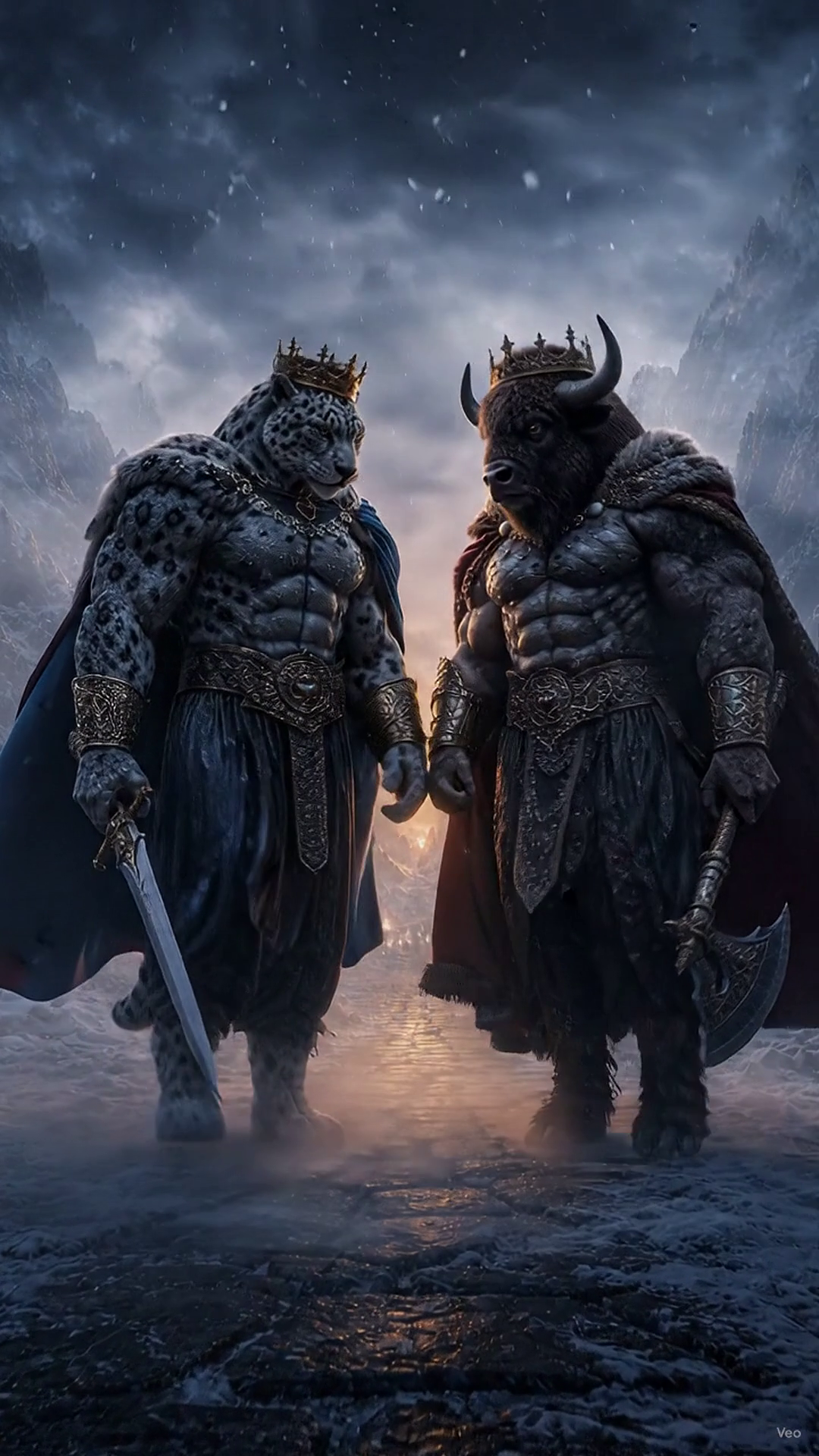
The Snow Leopard King and the Bison King met on the frozen road. No army stepped between them. No herald raised a horn. Only snow, steel, and breath moved as the two crowns closed the distance. The mountain would not remember who swung first. It would remember the moment neither king looked away.
The road between the two kingdoms had been built before either crown existed. It ran through the Teeth of Vald, a mountain pass so narrow that caravans had to fold their banners before entering it, so cold that iron gates cracked if opened too quickly after midnight. For generations, the road had belonged to no one. That was why everyone wanted it.
To the west lay the high stone keeps of the Snow Leopard King, white towers pressed into cliffs where scouts could vanish into blizzards and return with enemy plans folded under their cloaks. To the east lay the black pine valleys of the Bison King, broad meadows, deep forges, and fortresses built low and stubborn against the wind. The leopard realm knew speed, silence, and the thin law of heights. The bison realm knew weight, endurance, and the law of things that did not move.
They had traded along the road when the old queens still lived. Salt crossed east. Iron crossed west. Furs, grain, polished horn, mountain glass, and winter apples moved under seals both courts respected. Then one caravan vanished at the pass during a white storm. Each kingdom found only the part of the wreckage that proved the other side guilty. That is how wars often begin: not with certainty, but with evidence arranged by grief.
For nine months the border tightened. Snow leopard riders watched the ridge paths. Bison shield companies built signal towers in the valley below. Messengers were searched, then delayed, then turned away. At court, old insults dressed themselves as strategy. The young demanded honor. The old demanded caution. No one demanded truth loudly enough to be heard over the drums.
The final insult came with the thaw that never arrived. A bison bridge crew tried to repair the lower pass and found snow leopard blades planted point-first in the road, each wrapped with a strip of blue royal cloth. In the western keep, scouts returned with a bison war axe buried in the stone beside the leopard king's watch shrine. Both acts were too perfect, too theatrical, too useful to men who wanted war. By then usefulness mattered more than doubt.
So the armies marched. They did not meet at once. The road made armies wait. The pass allowed only narrow columns, and the cliffs punished haste with falling rock and white death. By dusk, the two hosts stood out of sight of one another, each camp hidden behind a bend in the frozen road. Fires burned low. Horses stamped. Bison soldiers wrapped their hands around spear shafts to keep from shaking. Snow leopard warriors listened to the wind and heard every possible ambush inside it.
Then the Snow Leopard King left his line. No captain gave permission. No guard was ordered to follow. He stepped onto the road with his crown dark against the snow and a sword hanging low in his right hand. He was immense, even for his bloodline, a ruler shaped by cliff wind and old hunts, spotted fur dusted with ice, shoulders broad beneath a blue-black cloak. His eyes fixed on the eastern bend as if the mountain had already told him who would appear.
From the other side came the Bison King. He did not stride quickly. He did not need to. Each step pressed into the frozen road with enough weight to make the ice answer. His crown rested between great black horns. Snow clung to the fur of his shoulders and the rim of his red cloak. In one hand he carried an axe, not raised for battle, only present, the way a throne is present even when no one sits on it.
The first soldiers who saw them wanted to move. That was instinct. Guards exist to close distance around a king. But the commanders on both sides held the lines back, because there are moments when a ruler becomes more dangerous if protected. The two monarchs had chosen the empty stretch between armies. To step into it unbidden would have been an insult neither side could survive.
Wind crossed the road. Snow moved in thin veils over the stones. The two kings kept walking. Far behind them, banners snapped and vanished behind curtains of mist. Somewhere a war drum began once, then stopped after a single beat. No one wanted to be the sound that broke the mountain's attention.
The Snow Leopard King spoke first when the distance had narrowed to spear length. He asked whether the bison crown had sent men to murder merchants in the storm. His voice carried without rising, smooth and cold enough to make the question feel like a blade laid flat on a table. The Bison King answered by asking whether the leopard crown had planted royal cloth on a road where widows would find it. His voice was lower, rougher, less quick, but it struck the pass with a force that made loose snow fall from the rocks.
Neither believed the other. That was the oldest trap of power. A king learns to hear lies so often that truth begins to sound like a better disguise. The leopard saw in the bison's stillness a refusal to confess. The bison saw in the leopard's calm a court trained to sharpen deceit until it glittered. Between them lay a road wide enough for two crowns and too narrow for mercy.
Yet neither struck. That mattered. Soldiers later argued about why. Some said the Snow Leopard King was waiting for the perfect opening. Some said the Bison King would not be the first to stain a neutral road. Others claimed the mountain itself held their wrists in the cold. The truth was simpler and harder to sing: both rulers saw the same doubt at the same moment, and neither trusted it enough to step back.
Behind the Snow Leopard King, high on a ridge, one of his scouts saw movement where no army should have been able to climb. Behind the Bison King, a shield captain noticed a signal fire flash three times from a tower that had been abandoned since winter. The pass had witnesses neither crown had summoned. The vanished caravan, the planted blades, the buried axe, the perfect insults: all of it had begun somewhere beyond the two armies now waiting to kill each other.
But kings do not become kings by looking away from the figure in front of them. The Snow Leopard King tightened his grip. The Bison King lowered his horns a fraction. Their breath mingled in the air between them, pale and brief. They were close enough now for each to see the scratches on the other's crown. Close enough to smell leather, iron, old snow, and anger. Close enough that the whole war seemed to fit inside one step.
That is the moment the songs remember, though the battle that followed lasted three days and killed men whose names deserve more than a verse. The songs remember the road before the first blow because everyone who survived understood that history had paused there. Two kingdoms stood behind two bodies. Two truths stood behind two accusations. And somewhere in the heights, unseen hands waited to learn whether pride could still be used as a weapon.
The mountain did not remember the first strike. Snow covered that mark before dawn. It remembered the silence before it, the two crowns closing the distance, the way neither king looked away, and the terrible fact that sometimes war begins not because enemies fail to meet, but because they meet too late.