Black iron gates opened under a dead moon. No trumpet announced the rider. No herald dared speak his name. Only the chains, the torches, and the wet stones answered as the Raven King crossed into the fortress. Behind him rode two armed guards from the same shadowed bloodline. Ahead of him waited a court that had locked its own ruler outside. The gates did not open for mercy. They opened because the night had returned with a crown.
This chapter is presented as a complete written tale with curated scene artwork from the realm archive.
The black iron gates of Corvath had not opened after sunset in forty years. The rule was older than the current court, older than the captain of the watch, older even than the stone ravens carved above the arch. At dusk the chains were drawn, the bars were locked, and no traveler, priest, merchant, soldier, or noble was allowed through until dawn. The people said it was for safety. The old families knew it was for fear.
Beyond those gates lay the road to the marsh towers, a strip of wet stone that crossed the moonlit lowlands and vanished into reeds where no honest fire burned. The road had once belonged to the Raven King. It was his patrols who kept the marsh clans from cutting the grain routes. It was his riders who carried warnings from tower to tower when enemy banners moved beneath the fog. It was his law that made Corvath rich enough to pretend it had never needed him.
That pretense began three winters earlier, when the court sealed the king outside his own fortress. They did it without shouting, which made the betrayal worse. There was a hunting procession, an argument at the north tower, a forged order carried by a trembling clerk, and then the gates were closed before the king returned. By morning, the council announced that the monarch had abandoned Corvath to chase omens in the marsh. The people were told stability required silence.
Silence was easy at first. The granaries were full. The soldiers still wore black steel. The market lamps still burned along the river steps. But a city can live for a while on the strength left behind by someone it betrayed. Then the strength runs out. Patrols stopped reaching the outer watchfires. Toll wagons disappeared in the marsh. The great bells rang for funerals so often that children began to sleep through them.
The council blamed weather, bandits, old curses, foreign spies, and any other enemy that did not have a face in the room. They never blamed the locked gate. They never blamed the forged order. They never spoke of the crowned rider who had been left beyond the walls with only two guards and the black road behind him. To speak of him would have meant admitting that Corvath had not lost its king. It had thrown him away.
On the night he returned, rain silvered every surface of the fortress. The gates shone like the backs of beetles. Torches hissed in their brackets. The captain of the watch was halfway through changing the guard when the first hoofbeat sounded from the marsh road. It came slowly, with the patience of something that did not need to hurry because the ending had already chosen a side.
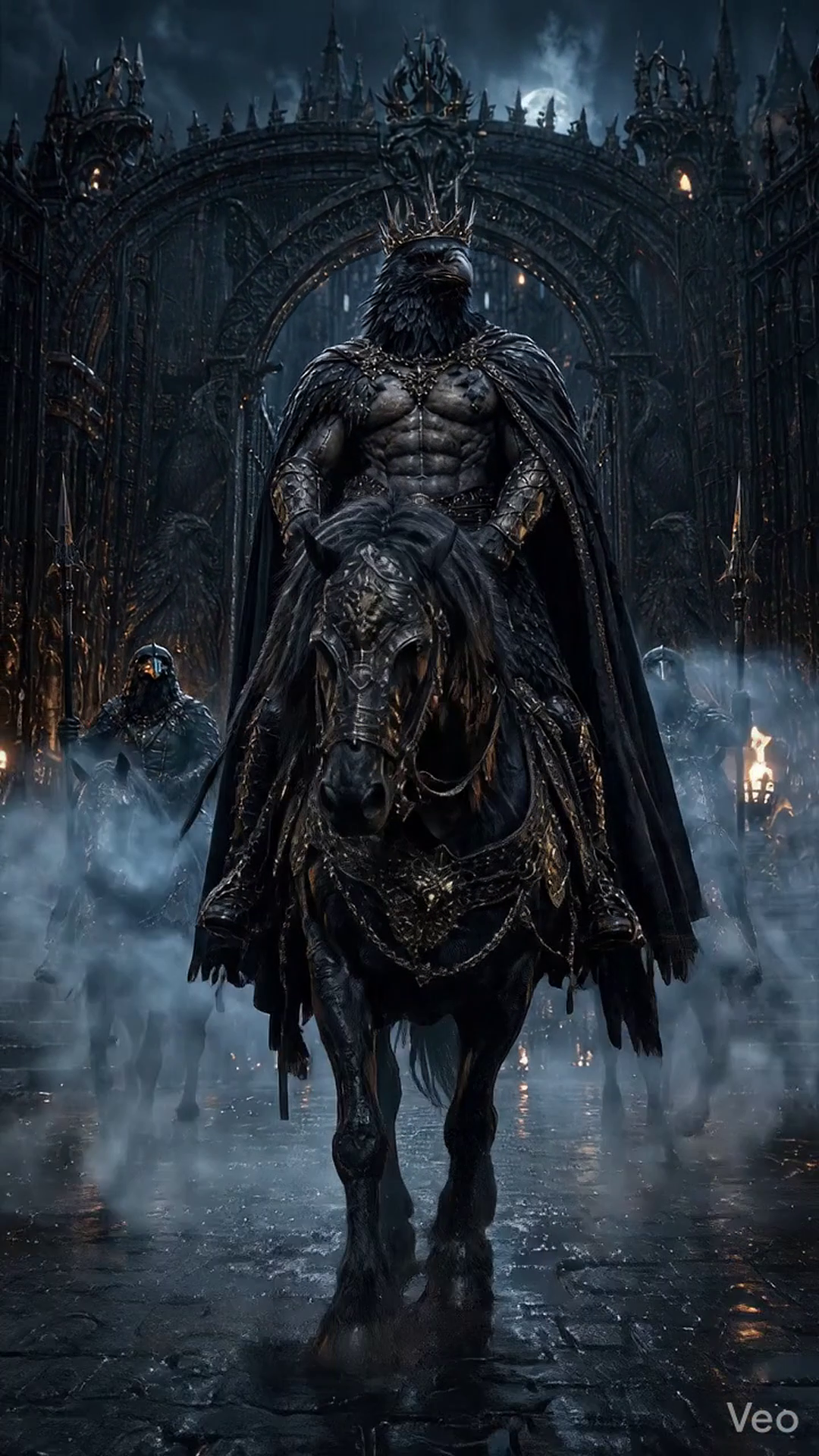
Three riders emerged from the blue mist. The two behind carried long spears upright, their black feathers slick with rain, their armor dark enough to swallow torchlight. They were smaller than the figure between them, but only because he made all other warriors look unfinished. The Raven King rode at the center on a black armored horse, bare-chested beneath a cloak that dragged shadow from the air itself. A spiked crown rose over his raven head, and his eyes held the cold shine of moonlight on steel.
No herald announced him. No army followed. That was what broke the courage of the gate guards. A marching force could have been resisted. A siege could have been named treason and answered with arrows. But three riders at midnight meant the king had not come to conquer the city from outside. He had come to remind it that the locks were only metal, and metal remembers the hand that first commanded it.
The captain ordered the chains held. His voice cracked before the sentence finished. The Raven King did not look at him. He looked at the gate itself, at the carved birds above the arch, at the old royal seal scratched and painted over by men who believed stone could be taught to lie. Then he lifted one hand from the reins. The horse stopped. The rain seemed to stop with it.
The two guards behind him lowered their spears until the blades caught the torchlight. They did not charge. They did not threaten. Their stillness was worse. Every soldier on the wall understood that these three had crossed the marsh road at night, through places where patrols now vanished, and had arrived without a scratch. Whatever fear kept Corvath locked after sunset had already stepped aside for them.
The chains began to move. Later, the council claimed the gate master acted without orders. The gate master claimed he had heard the old mechanism answer the king before his hands touched the wheel. The truth mattered less than the sound. Iron groaned through the courtyard. Bars lifted from their sockets. The doors opened inward, and the road that had been forbidden after dusk entered Corvath with him.
When the Raven King crossed beneath the arch, no one knelt at first. People forget their own customs when terror returns wearing a crown. The horse moved over the wet stones, each hoofbeat spreading through the courtyard like a verdict. The king kept his head high, beak angled toward the palace windows where candlelight flickered behind closed shutters. He knew who was watching. He knew which hands had signed the false order. He knew which mouths had repeated the lie until it sounded almost lawful.
At the palace steps, the council waited in ceremonial robes they had put on too quickly. Some wore chains of office over nightclothes. Some had forgotten gloves. Lord Veyr, who had read the proclamation of abandonment three winters earlier, stepped forward with a scroll in his hand. He began to speak of confusion, emergency powers, disputed succession, and the need to preserve unity in dangerous times.
The Raven King listened from the saddle until the rain erased the ink at the bottom of the scroll. Then he asked one question: who had kept the marsh road open while Corvath slept behind locked gates? No councilor answered. The two guards behind him had buried friends along that road. The king himself had ridden it through fog, fever, and ambush while the city called him absent. The question did not need an answer. It needed witnesses.
His judgment came without rage. The forged order would be nailed to the gate where every citizen could see it. The council seats would be emptied before dawn. The families of the lost patrols would receive the estates of those who had profited from the lie. Corvath would reopen the marsh road, not for trade at first, but for repair. Every noble house that had voted to seal the gates would send sons, daughters, stone, horses, and gold to rebuild the watchfires they had let die.
Some called it revenge. The Raven King called it memory given work. Revenge would have filled the courtyard with bodies. Memory put tools in guilty hands and made them carry lanterns into the dark they had ignored. By sunrise, the black iron gates stood open, and the first repair wagons rolled toward the marsh under guard. The city watched in silence as the Raven King rode at their head, not away from Corvath, but into the road the city had pretended no longer mattered.
That is why the old gate law changed. The doors still close at dusk, but they do not lock until the watch captain looks down the marsh road and speaks the king's name. Children are told the rule is tradition. Their grandparents know better. They remember the night the chains moved by themselves, the night three riders came through the mist, the night Corvath learned that a crown left outside in the dark may return sharper than before.