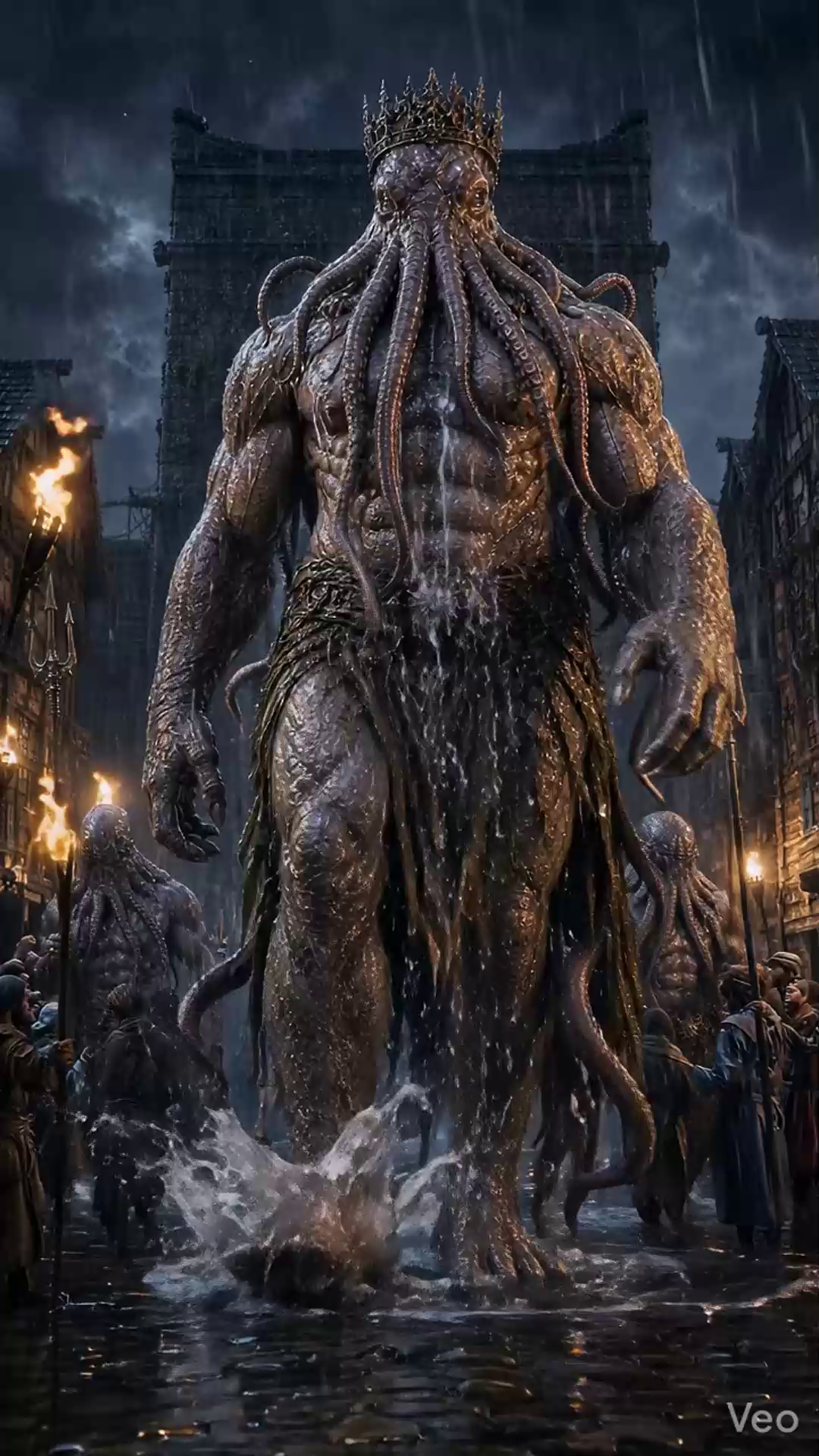
The Octopus King entered the flooded harbor village in the rain. No bell rang. No door stayed open. Only torches and tridents watched him pass. Behind him walked two smaller guards of the same deep bloodline, weapons held above the black water. The villagers had asked the sea for mercy. The sea sent its king.
This chapter is presented as a complete written tale with curated scene artwork from the realm archive.
The village of Brinegate had been built where the river surrendered to the sea. Its houses leaned over black water on timber legs. Its market stones were always damp. Its bells were green with salt, and every family kept a rope ladder by the upper window because storms could turn the streets into canals before a candle burned halfway down.
Brinegate survived by honoring the tide law. When the moon pulled the harbor high, the village opened the lower gates and let the sea move where it wished. When the sea withdrew, the people swept mud from their thresholds, repaired their nets, and left tribute at the old stone arch: fish oil, black pearls, copper hooks, and one lantern kept burning for the crown beneath the waves.
The tribute had not made them rich, but it had made them safe. No reef raider entered Brinegate after sunset. No plague ship anchored in its harbor. No storm broke the sea wall beyond what carpenters could mend. The elders said protection had a price. The young said fear had learned to call itself wisdom. In the seventh year of lean catches, the young won.
They sealed the lower gates with iron braces. They kept the pearls. They sold the fish oil inland. The lantern at the old stone arch burned out during a hard rain, and no one crossed the flooded square to light it again. At dawn, Elder Marwen told the village that the sea had many kings in stories, but stories did not feed children.
For three days the harbor lay strangely calm. Nets came up heavy. The tide stopped just below the steps, polite as a servant. Men who had argued against the elders began to look foolish, and the taverns filled with laughter loud enough to drown old warnings. On the fourth night, every well in Brinegate tasted of salt.
By midnight, the rain arrived. It did not fall like weather. It struck like a verdict. Water pushed under doors, lifted barrels, dragged chicken coops from yards, and turned the market lane into a moving black mirror. The lower gates groaned against their iron braces until the hinges screamed. Then the old stone arch opened by itself.
The first thing the villagers saw was the crown. It rose beyond the rain at the far end of the flooded street, jagged gold against the storm clouds. Then came the face beneath it, an enormous octopus head, wet and dark, its eyes fixed forward with a patience older than anger. Tentacles moved over a chest broad enough to shame a fortress door.
The Octopus King stepped through the gate as if the village had been built for his stride. Water leapt around his feet. Rain streamed across the ridges of his skin and gathered in the suction cups of the tentacles that hung from his face. He wore no armor over his torso. He needed none. Muscle and old sea-scar made a stronger proclamation than steel.
Behind him came two guards of the same deep bloodline. They were smaller than their king the way towers are smaller than cliffs. Each held a trident upright in both hands, the points bright with torchlight. They did not threaten anyone. They did not need to. In Brinegate, the sight of armed silence was worse than a shouted command.
Villagers pressed themselves against walls and doorframes. A cooper climbed onto a rain barrel with his daughter in his arms. Fishermen who had laughed in the tavern now lowered their eyes into the flood. Elder Marwen stood near the well with his ceremonial chain half-fastened, trying to look like a man receiving a ruler instead of a man waiting for judgment.
The Octopus King stopped where the market stones disappeared beneath the water. He looked at the sealed lower gates, at the dark lantern, at the empty tribute niche carved beneath the arch. No one spoke. Even the storm seemed to make room around his silence. The king raised one massive hand and touched the dead lantern with a clawed finger.
A blue flame woke inside the glass. It did not flicker in the rain. It burned cold and steady, and every villager felt the old stories return to the square, not as songs but as debts. Brinegate had not merely failed to pay tribute. It had tried to shut the sea out of a village whose foundations were borrowed from the sea.
Elder Marwen lowered himself into the flooded street until the water reached his chest. He said the catch had been poor, the children hungry, the winter cruel. None of it was false. That made the answer harder. The Octopus King listened without blinking, and the two guards behind him held their tridents so still that rain ran down the shafts in silver lines.
At last the king turned his eyes across the village. His judgment was not the drowning the guilty feared. The iron braces would be removed before dawn. The tribute would be restored, but no pearl would be taken from a family that had no bread. Every able fisher would spend one month repairing the reef markers and storm chains that kept the harbor safe. The elders who ordered the gates sealed would work beside the youngest sailors until their hands remembered the law they had mocked.
Then the king named the price no one expected. For one year, the village would keep the lower streets open at every high tide. The sea would pass through Brinegate in full view of every child, every merchant, every proud young voice that had mistaken mercy for weakness. They would learn again that water does not ask permission to return to what once belonged to it.
When the Octopus King moved on, the flood followed him without rising another inch. His guards passed behind him, tridents upright, faces hidden by rain and torchlight. No one cheered. No one cursed. Brinegate watched the crowned giant vanish deeper into the harbor road, and the people understood that the sea had not come to destroy them. It had come to remind them that survival is not ownership.
By morning, the lower gates stood open. The old lantern burned blue beneath the arch. Children carried oil beside their parents, and the first boats left the harbor under a sky still bruised by storm. Years later, when Brinegate grew rich again, the elders would point to the tide marks on the market walls and tell the story plainly. The village asked the sea for mercy. The sea sent its king.