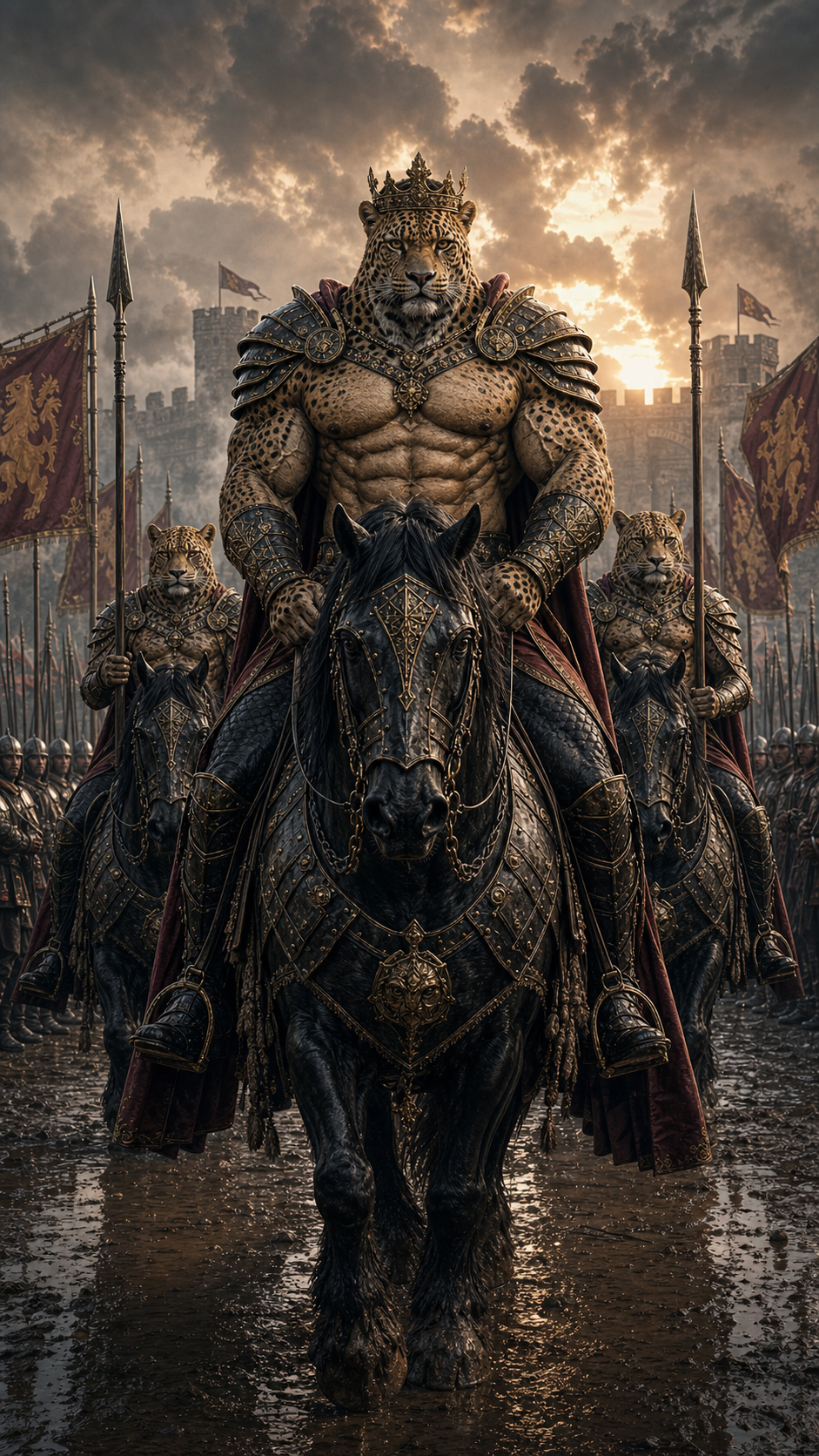
The army did not cheer when the Jaguar War Monarch rode between them. They lowered their spears. They held their breath. The black horse kept walking. Behind him came two royal guards. Ahead of him waited the enemy road. No speech. No mercy. Only hooves in the mud before the banners moved.
This chapter is presented as a complete written tale with curated scene artwork from the realm archive.
The army had been ordered into two ranks before the sun cleared the eastern ridge. By then the road outside the fortress was already churned into black mud, and the banners above it were heavy with rain. Men stood shoulder to shoulder in iron helms and leather coats, their spears angled toward a sky that looked too low for mercy. No drumbeat held them steady. No priest walked the line. Every soldier waited for the same gate to open.
They called him the Jaguar War Monarch because no smaller name survived him. In the old murals he was painted as a hunter with gold eyes, bare claws, and a crown of night bronze. In the barracks he was spoken of more carefully. Veterans said he had crossed the ash hills on foot after his horse was killed beneath him. Border captains said he could smell a false oath before the ink dried. Children in the capital were told that if they lied beside an open window, the monarch's spotted shadow might pass across the wall.
The soldiers did not believe every story. They believed enough.
Inside the fortress yard, the black horse was brought out beneath torchlight. Its armor had been polished until each plate reflected flame like water under a storm. The animal stood still while grooms fastened the last straps, but the stillness had nothing gentle in it. It looked less like a mount waiting to be ridden and more like a weapon waiting to be lifted.
When the monarch emerged, the yard fell silent in a way even stone seemed to understand. He was taller than any rider there, broad through the shoulders, massive through the arms, his spotted fur marked by old scars and half hidden under dark war harness. Gold lay across his chest in heavy chains. A cloak, torn at the bottom from older campaigns, dragged behind him in the mud. The crown above his brow did not glitter. It glowered.
Two jaguar guards followed him from the archway. They were royal-blood warriors, powerful enough to frighten most courts by themselves, yet smaller beside him in the way mountains make towers look modest. Each carried a long spear with a black pennant beneath the blade. They did not speak to the grooms. They did not glance at the waiting captains. Their attention stayed on the monarch, and through him, on the war that waited outside the gate.
The enemy had crossed the river three nights earlier. Not with a formal declaration, not with banners raised in clean daylight, but with raiders, fire, and rope. They burned the granaries at Marden Field. They cut the bridge at Voss. They dragged the old road wardens from their posts and left the royal seal broken in the dirt. By dawn, refugees were already climbing the fortress road with smoke in their hair.
The council had argued for delay. Every council argues for delay when the cost of action has not yet reached its own doors. The monarch listened until the maps were crowded with pointing fingers and careful excuses. Then he stood, placed one claw on the river crossing, and said only that the army would form by morning. No one asked him to repeat it.
Now morning had come, and the northern gate opened.
The black horse stepped through first, iron hooves sinking into the mud with slow royal weight. Then the soldiers saw the rider above it. The Jaguar War Monarch entered the road between the ranks without raising a hand, without turning his head, without offering the kind of speech men later invent to make fear easier to remember. His silence did the work more cleanly.
Spears lowered as he passed. Some soldiers bent their knees. Some only bowed their heads because their legs would not trust them. The monarch's golden eyes stayed forward, fixed on the road beyond the army and the unseen river beyond that. Rain ran over his crown and down the scar that crossed his muzzle. The black horse kept walking.
Behind him, the two royal guards rode in perfect measure. Their spears remained upright, blades dark against the morning cloud. They were not ceremonial witnesses. Every man in the ranks knew that. Those guards had carried the monarch's orders through broken gates, night marshes, and winter sieges. If they rode behind him today, it meant the choice had already been made and the court had already become irrelevant.
A young shieldman near the center rank forgot to breathe until the horse was almost past him. He had joined the army three months before for coin, food, and the promise that border trouble rarely reached the main road. Now the ruler of the realm moved within arm's reach, and the shieldman understood that kings were not distant because they were unreal. They were distant because seeing one this close made obedience feel like a physical thing.
The monarch slowed at the final gap between the ranks. For a moment the entire army seemed to lean toward him, waiting for a command, a blessing, a threat, anything that could be carried into the day ahead. The rain clicked against helms. Banners snapped in the wind. The black horse exhaled steam.
Still the monarch said nothing.
That was why the soldiers remembered it years later. Words could have promised victory. Words could have lied beautifully. Silence forced each man to know exactly what was being asked of him. The monarch had ridden down from the fortress not to hide the cost of war behind glory, but to look at the army that would pay it and let the army look back.
Then he moved forward again. The guards followed. The first rank stepped into the prints his horse had made, and the second rank moved after them. The road that had waited all morning began to fill with steel, mud, breath, and the low thunder of an army choosing motion because stillness had become a worse danger.
By midday, the fortress would be behind them. By night, the river would hear the first cannon. But the men who survived would not begin the story there. They would begin with the road, the lowered spears, the black horse, and the crowned jaguar riding through the silence before the banners moved.