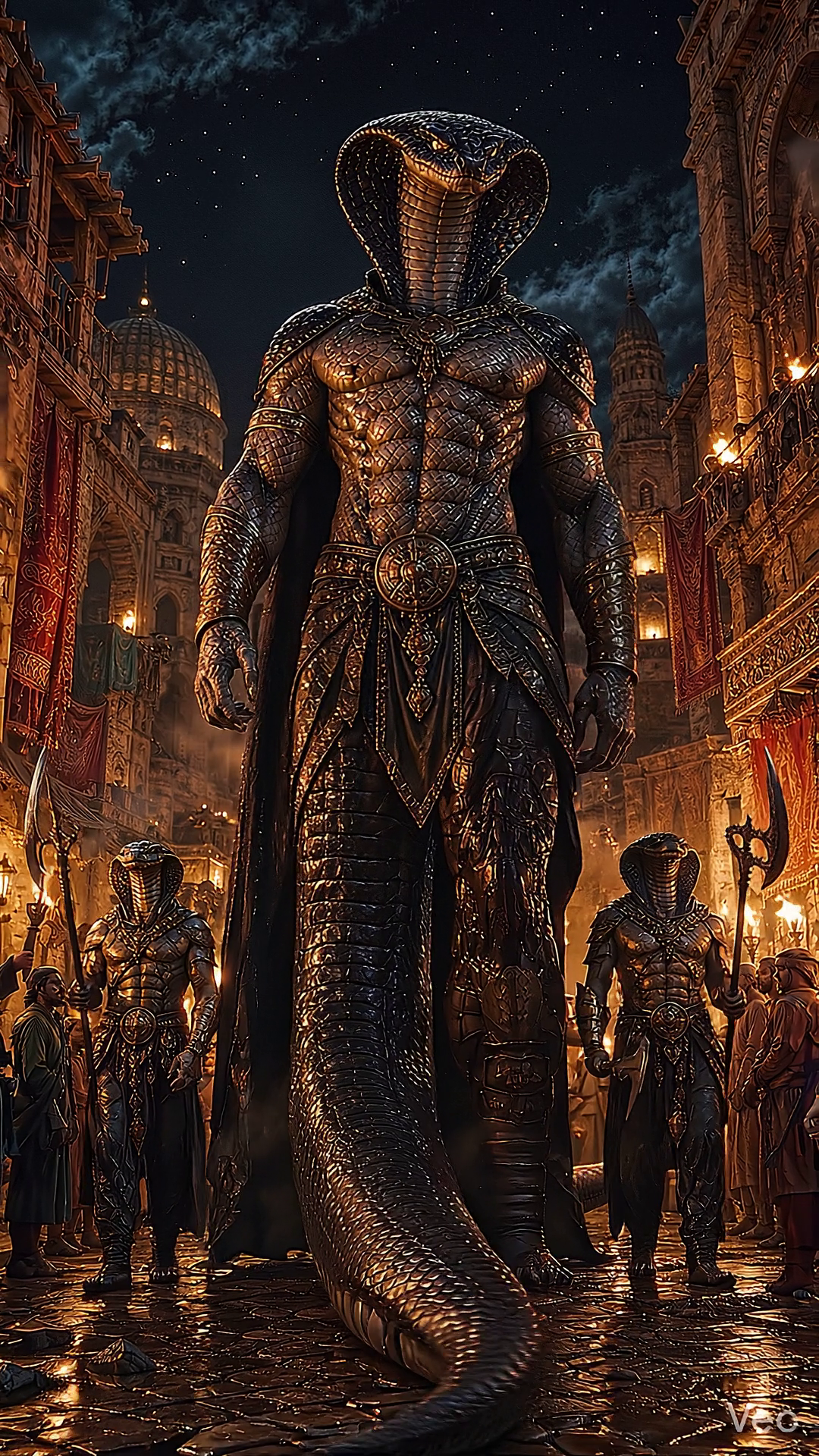
The Cobra King entered the torchlit village without a word. Two armed guards moved behind him. The torches bent. The crowd stepped back. No throne room waited for him, only a road that remembered who ruled it.
This chapter is presented as a complete written tale with curated scene artwork from the realm archive.
The village of Sareth was built where the desert road narrowed between two walls of black stone. By day, it looked almost harmless: sandstone roofs, spice awnings, bronze water jars, and children running barefoot between the stalls. By night, when every torch was lit and the dunes beyond the gate vanished into darkness, the village remembered what it had been made to guard.
Long before the market grew rich, before the domes were gilded and the wells were lined with carved tile, the Serpent Crown had claimed that road. The first Cobra King had opened it with soldiers, iron hooks, and graves. Raiders once waited in the ravines above Sareth, taking caravans, cutting throats, and leaving merchants for the vultures. The Cobra Crown ended that age. In return, Sareth swore an oath: the road would remain loyal, the wells would remain open, and every caravan that passed beneath the serpent gate would honor the crown.
Prosperity made the oath sound old.
The council of Sareth began with small omissions. One tribute wagon delayed by a sandstorm. One royal banner left folded during a festival. One crown tax recorded as a local repair fee. Each excuse seemed practical when spoken under painted ceilings with wine on the table. Then came the year of full defiance. The serpent seal was removed from the eastern arch. The crown's tax house was locked. The council announced that Sareth was a free road now, owing nothing to a ruler beyond the dunes.
The village celebrated for six nights.
On the seventh night, the torches burned blue at their tips.
No messenger came first. No herald blew a horn. The western gate simply opened, though every guard on duty later swore his hands had not touched the bar. Wind moved down the main road and carried sand across the wet stones. The crowd turned toward the gate in pieces: first the spice sellers, then the water carriers, then the children, then the councilmen who understood too late that some kings do not send warnings because arrival is warning enough.
The two guards entered first.
They were cobra warriors of the crown blood, smaller than their king but still taller than any man in Sareth. Their hoods rose behind polished helms. Gold caught along the scales of their arms. Each held a hooked polearm upright in both hands, the blades dark and bright at the same time under the torchlight. They did not point the weapons at anyone. That made the weapons feel worse.
Then the Cobra King came through the gate.
He towered above the road as if the old serpent statue from the temple had stepped down and remembered how to breathe. His hood was wide enough to catch the light from both sides of the street. His bare scaled chest and massive arms shone with black, bronze, and gold. A crown rested above his eyes, not delicate, not decorative, but heavy with the kind of authority that does not need to ask whether it is recognized.
The crowd moved back from him without being ordered. Sandals scraped stone. Doors shut and opened again. A woman pulled her son behind a water cart and covered his mouth before he could ask a question. The Cobra King did not look left or right. He moved forward with slow royal weight, his long serpent body drawing a dark path across the torchlit road.
Councilman Hareth stepped into the street because pride had brought him there and fear would not let him leave. He wore the red sash of Sareth's elected speaker. He had been the first to argue that the Serpent Crown was too distant to matter. He had told the village that no king who crawled through dust could command a city of stone. Many had laughed when he said it. None laughed now.
Hareth bowed, but the bow came late.
The Cobra King stopped before him. Behind the king, the two guards stopped as one, polearms still upright, their scaled faces fixed on the road ahead. The torches along the balconies hissed in the wind. Somewhere in the market, a copper tray fell and rang against the stones. The sound traveled farther than it should have.
Hareth began with practical language. The village had suffered from poor caravan seasons. The wells required repair. The crown's old records were unclear. Perhaps the tax house had been locked by mistake. Perhaps the serpent seal had been taken down only for cleaning. Each word entered the air neatly and died there.
The Cobra King listened without moving.
That was what frightened the villagers most. Anger would have given them something familiar. A shout could be answered by apology. A threat could be measured. Silence from a king that large made every excuse feel like a coin dropped into a well too deep to hear.
At last, the Cobra King looked past Hareth to the bare arch where the serpent seal had once hung. The empty place above the gate seemed to darken under his gaze. Sareth had not merely failed to pay. It had tried to remove the memory of protection and keep the profit protection had made possible.
The terms came quietly. Before dawn, the serpent seal would return to the eastern arch. The tax house would open in the square, not in private. The council would surrender the false ledgers and name every merchant who had signed them. The unpaid debt would not be taken in bread from hungry families. It would be paid in stonework, watch service, repaired wells, and guards posted along the ravine road for one full season.
Hareth asked what would happen if Sareth refused.
The Cobra King lowered his head until the torchlight caught both golden eyes. No guard moved. No blade rose. The answer did not require theater. He said the desert keeps perfect account of roads that forget who cleared them.
By midnight, men were climbing the eastern arch with ropes. Women carried the old seal from the cellar where it had been hidden beneath grain sacks. Children watched as sand was brushed from the bronze serpent face. When the seal rose again over the gate, the whole village saw how small the arch looked beneath it.
The Cobra King remained in the road until the work was done. His guards stood behind him with their polearms in their hands, silent and armed, as if they had been carved from the same dark law. No one sang. No one celebrated. The village had learned that freedom built on forgotten debts is only another kind of trap.
Near dawn, the king turned back toward the western gate. The torches had burned low. The sky beyond the domes was beginning to pale. Hareth knelt in the dust with the red sash folded in his hands, waiting to be told whether he still had a name worth carrying.
The Cobra King gave no punishment the crowd could cheer and no mercy the council could twist into victory. He left them with the road. That was enough. Every caravan that passed through Sareth after that saw the serpent seal above the arch, newly polished and impossible to ignore.
Years later, old villagers would tell children that the torches sometimes bent toward the western gate before a sandstorm. They would say it meant the desert was listening. Then they would lower their voices and add the lesson Sareth had paid so dearly to learn.
When the Cobra King enters your village, do not explain the oath. Open the gate and remember it.