From the high balcony above Andor, the Leonine King raised his arms and the entire nation fell silent. The queen, his family, and the royal court stood behind him. Below, thousands waited in the avenue beneath the red banners. Then his voice carried across the city: "Great people of Andor, the time for celebration has arrived." But in kingdoms built on old blood and older secrets, celebration is never just celebration.
This chapter is presented as a complete written tale with curated scene artwork from the realm archive.
The bells of Andor had been silent since dawn. That alone was enough to frighten the city. On feast days they rang from the copper towers. On days of mourning they answered one another slowly across the river. On days of war they shattered the morning before the first banners left the gates. But on this day, with every balcony dressed in burgundy silk and every avenue filled from wall to wall, the bells did not speak at all.
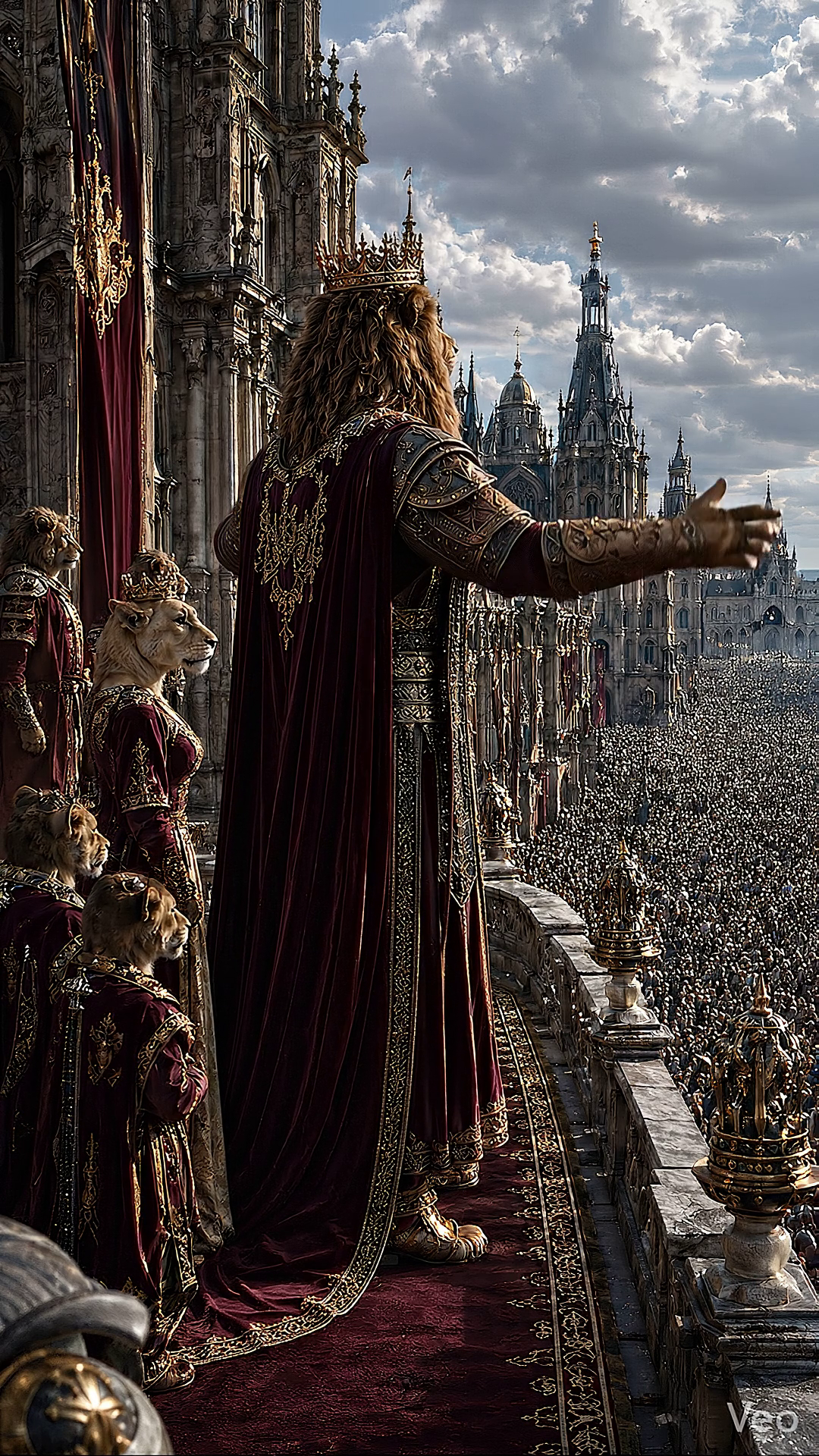
People came anyway. Bakers left their ovens banked low. Smiths let their fires cool. Children climbed onto rain barrels and soldiers stood shoulder to shoulder along the edges of the square, trying to keep the crowd from spilling into the palace steps. By noon the grand avenue had become a living sea of faces, thousands of citizens pressed beneath red royal banners and the long shadows of Andor's gothic towers.
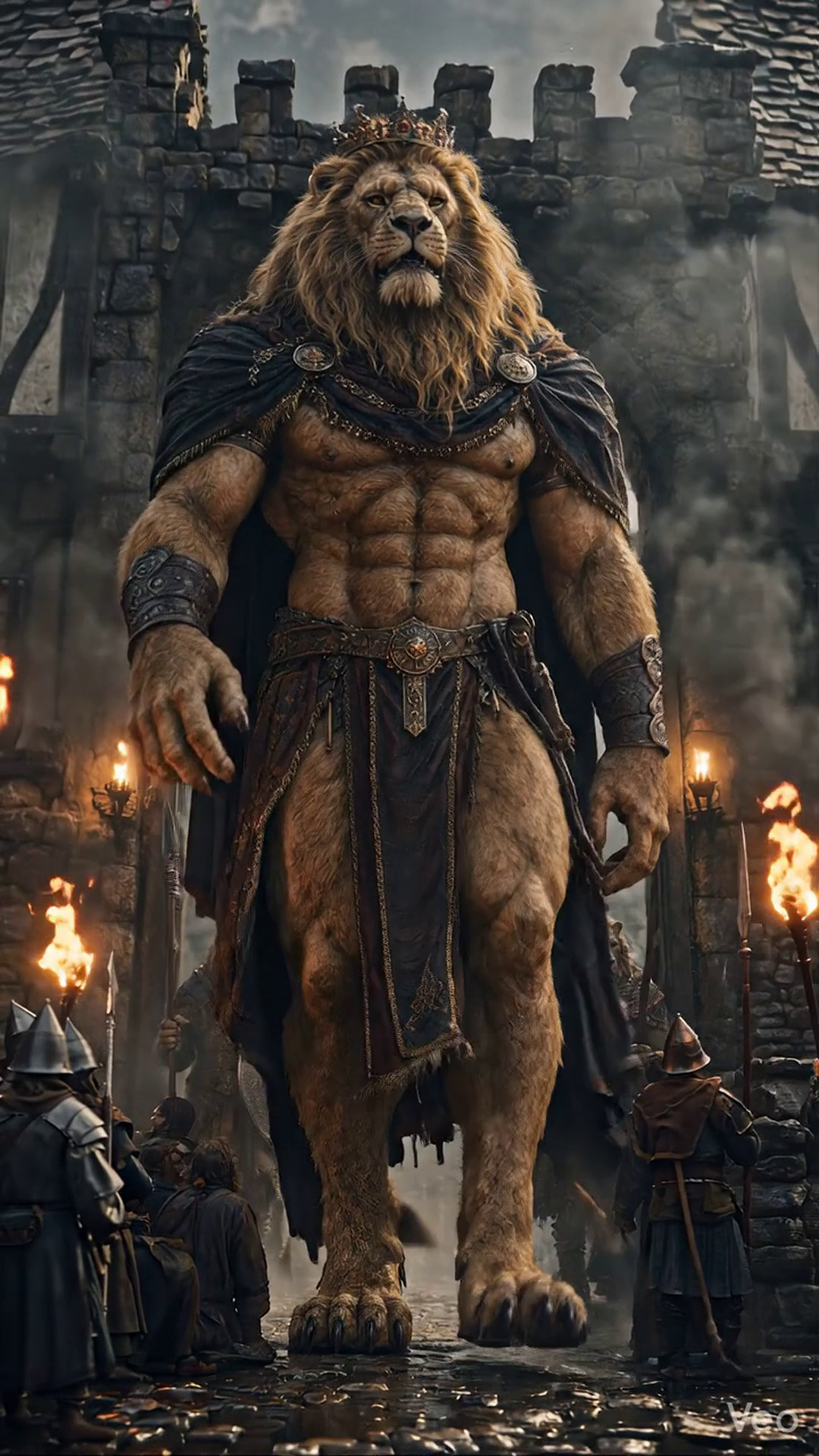
Above them, on the high royal balcony, the leonine king waited at the front edge of the stone dais. He was larger than the stories made him, broad shouldered and crowned in hammered gold, his mane moving slightly in the wind that came over the palace roofs. Burgundy cloth fell from his armor in heavy folds. Gold thread caught the sun at his shoulders and wrists. He did not need to roar for the crowd to remember who ruled them.
Behind him stood the queen and the royal bloodline of Andor. The queen wore burgundy and gold, elegant as a blade kept in velvet. The young princes and princesses stood near her in formal silence, their faces trained into the difficult stillness expected of those born too close to a throne. Other leonine nobles filled the balcony behind them, arranged like living heraldry beneath the carved stone arches.
The people below could not hear what passed among the royals, because nothing passed at all. No whisper. No gesture. No nervous adjustment of a crown or sleeve. That silence mattered. It told the crowd that this was not a festival announced by stewards, nor a small blessing given from a decorated window. The king had brought his family into view because whatever he was about to say belonged to the whole house.
Rumors had crossed Andor for seven days before the gathering. Some said the border war was over. Others swore the missing heir had been found in the northern valleys. Merchants claimed a foreign embassy had entered the city by night. Old women at the wells said the palace kitchens had prepared for three hundred guests, which meant either a wedding, a trial, or a funeral disguised as a feast.
The king let the murmurs live beneath him. From the balcony, they sounded less like speech than weather: a low, constant movement of fear, hope, hunger, curiosity, and old grievance. He looked down the avenue until the crowd blurred into the bright distance between the towers. Somewhere beyond that distance lay farms that paid his taxes, forges that armed his soldiers, shrines where his name was spoken in prayer and complaint.
At last he raised both arms. The gesture was small for such a powerful body, controlled and royal, palms opening slightly toward the people as if he were steadying the city itself. The murmur lowered at once. A few banners snapped in the wind. A child cried out and was hushed. Even the guards along the steps seemed to grow taller, as though the king's movement had pulled a hidden wire through every spine in the square.
When he spoke, his voice carried farther than any horn. It rolled from the balcony, struck the stone fronts of the palaces, and returned over the crowd like thunder made into language. "Great people of Andor, the time for celebration has arrived."
For one breath, joy moved through the avenue. It rose first in the young, who heard only the word celebration. It spread to merchants who imagined open gates and full inns, to mothers who imagined bread at public tables, to soldiers who imagined leave from the barracks. The king did not smile. That was the first thing the old men noticed. The queen did not move. That was the second.
The celebration he promised was not the soft kind. Andor had not been built on softness. It was a kingdom of towers, oaths, and lions carved above every gate. Its feasts remembered victories, and its victories remembered graves. When a king called the nation to celebrate from a balcony instead of a hall, he was not merely giving permission to sing. He was telling the people what story they were expected to believe next.
Below the balcony, the crowd began to cheer because crowds are often braver as one body than any single person inside them. Yet under the cheers ran questions no one dared speak aloud. What had been won? Who had paid for it? Why had the whole royal family been shown? Why did the king announce joy with the face of a commander preparing to spend lives?
The leonine king lowered his arms slowly, and the sound of the city folded around him. In that moment he looked less like a ruler celebrating peace than a guardian deciding how much truth a nation could survive at once. Behind him, the queen watched the same crowd with eyes that had learned to count danger before applause. The children stood still, beautiful and trapped inside history before they were old enough to understand it.
That was how Andor remembered the day: the king above them, the red banners moving, the crowd roaring because it had been told to rejoice. Years later, when the songs made the announcement simple, the oldest citizens would correct the singers. They would say the celebration began that afternoon, yes, but so did the question that followed it. In a kingdom ruled by lions, even glad tidings could arrive with claws.