The cracked road gave them more than enough room to turn back. The Scorpion King crossed it anyway. Across the ash and broken pillars, the Rhinoceros Beetle King lowered his horn and began walking too. No guards. No drums. No army in the frame. Just two crowns closing the distance before the desert decided which kingdom would break first.
The battlefield of Karath had not been chosen because it was holy. Nothing living called it holy anymore. The old temple columns leaned like broken teeth across miles of cracked earth, and the wells below them had tasted of iron since the last dynasty died. Yet every road between the western stinger clans and the eastern horned citadels passed through that dead plain. Whoever held Karath did not merely own dust. He owned passage, tribute, salt, copper, and the right to decide which caravans reached the sea.
For a century, that right had been divided by treaty. The Scorpion King ruled the western shelves, where black stone caught the heat of the sun and every fortress was built with hidden doors below the sand. His people were patient because the desert taught patience cruelly. They survived by watching shadows, counting water skins, and striking only when a mistake had already been made.
The Rhinoceros Beetle King ruled the eastern citadels, massive black towers cut into the basalt ridges beyond the dry riverbed. His kingdom did not move quickly, but it did not need to. Its soldiers built walls where other rulers built speeches. Its miners dug deep enough to make the ground tremble. Its merchants drove armored wagons under banners marked with the great horn, and very few bandits were foolish enough to test them.
Between those powers, peace had never been friendship. It was arithmetic. The scorpion realm needed the beetle forges. The beetle realm needed the western salt road. Both courts knew the price of war, and both courts were proud enough to forget it whenever younger voices filled the hall.
The first fracture came from a caravan found burned beside the fifth column of Karath. The wagons carried royal seals from both kingdoms, which should have made them untouchable. Instead, every guard was dead, every ledger missing, and every water barrel split open so the desert could drink the evidence. A scorpion scout found a beetle horn crest pressed into the ash. A beetle patrol found three black stingers arranged on a stone altar. Each sign was almost too clear. Clarity is a dangerous thing when anger is waiting to use it.
In the west, ministers urged the Scorpion King to answer with poison raids against the eastern watchtowers. In the east, generals urged the Rhinoceros Beetle King to seal the trade road and starve the stinger clans into confession. Both rulers heard advice that sounded like justice and smelled like ambition. Men who never stand in the open are often loudest when recommending war.
For seven days, messengers crossed the desert and returned with colder words each time. Restitution became accusation. Accusation became threat. Threat became mobilization. By the eighth dusk, both armies stood beyond the edge of Karath, far enough from each other to avoid a mistake, close enough for every soldier to imagine one.
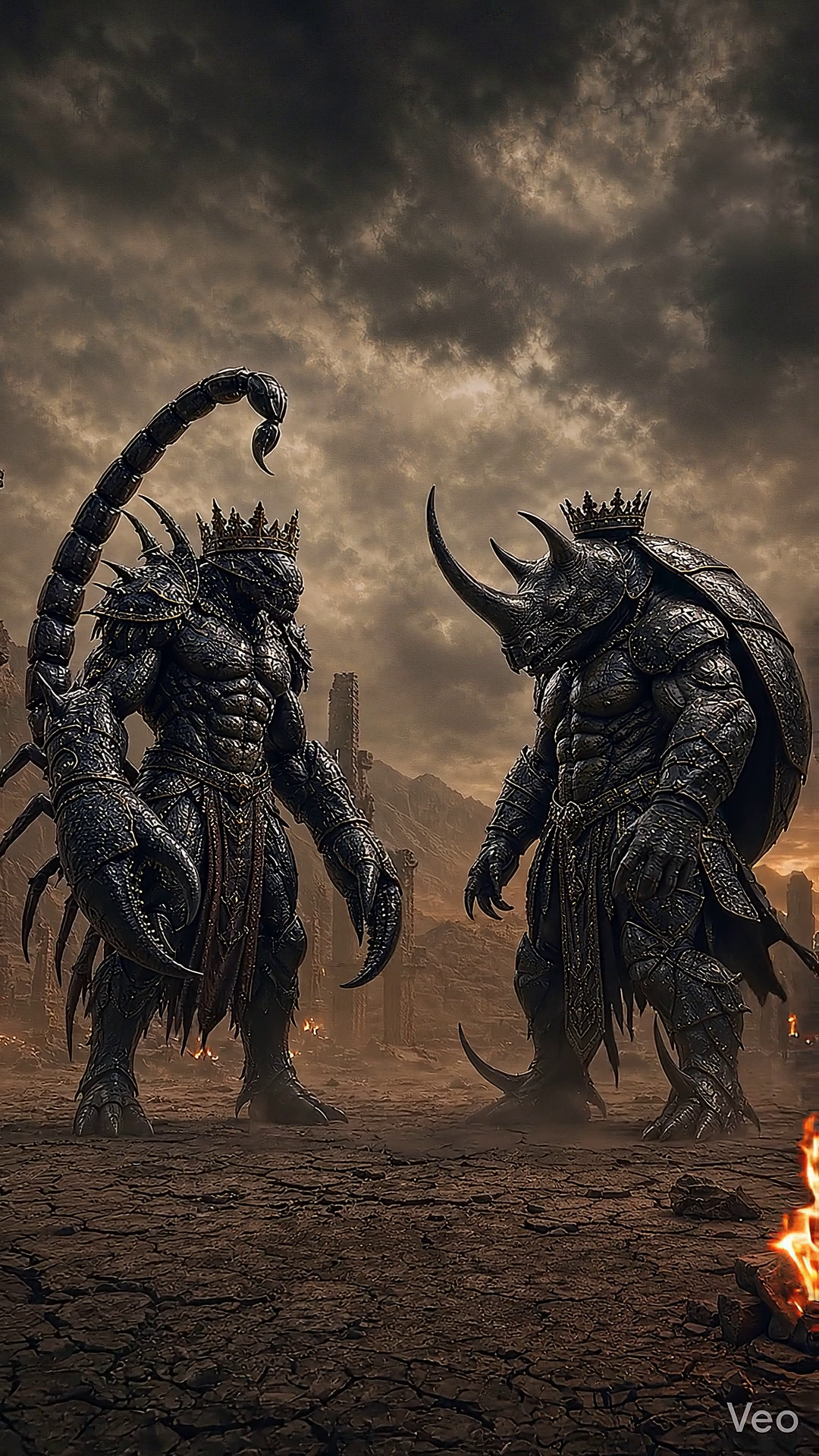
Then the Scorpion King left his line alone. No guard followed. No herald announced him. His black chitin caught the last bronze light of the storm sky, and his crown looked small only because the body beneath it was enormous. His tail rose behind him in a slow arc, not striking, only balancing the weight of his advance. Each step placed clawed feet onto cracked earth that had swallowed older kings than him.
Across the field, the Rhinoceros Beetle King began walking too. He was broader than rumor had promised, a living wall of horn, shell, muscle, and iron-dark patience. The great forward horn lowered slightly as he moved, but not enough to become a charge. His crown sat behind it like a challenge carved in gold. The plates along his back shifted with each heavy step, catching firelight from the ruins.
The armies watched from beyond the frame of history. That was how the old scribes later described it, though no scribe had been brave enough to stand near the road itself. Two kings crossed the empty stretch between them without guards, without witnesses close enough to interfere, without the comfort of hiding behind command. The desert made every step visible. Dust rose around their feet and drifted away before it could choose a side.
At first, the distance between them seemed large enough to save both kingdoms. A ruler can still turn back when the other crown is far away. Pride can still be renamed restraint. Anger can still be dressed as investigation. But the Scorpion King did not turn. The Rhinoceros Beetle King did not slow. With each step, the space where peace might have stood became smaller.
The Scorpion King spoke when they were close enough for the wind to carry a voice without help. He asked whether the eastern court had ordered the burning of the caravan. The Rhinoceros Beetle King answered by asking whether the western clans had arranged the false crests. Neither voice rose. That made the questions worse. Shouting can be dismissed as passion. Controlled anger sounds like judgment already written.
The truth, if either ruler had reached for it, lay somewhere behind both armies. Someone had wanted the road sealed. Someone had known which symbols would wound each kingdom most deeply. Someone had understood that the easiest way to move kings is to make them believe they are standing still for honor.
But knowledge is not the same as trust. The Scorpion King saw the horned ruler in front of him and remembered caravans that had vanished near eastern walls. The Rhinoceros Beetle King saw the tail raised behind the western crown and remembered treaty clauses written so sharply they might as well have been blades. Both kings had spent their lives learning to survive traps. Neither could yet see that the trap was large enough to hold them both.
They stopped at striking distance. No blade moved. No claw fell. The Scorpion King's pincers opened and closed once, slow as gates. The Rhinoceros Beetle King planted his feet and let the horn cast a long shadow across the cracked road. Behind them, fires burned in the ruins as if the dead city of Karath had opened its eyes to watch.
That moment became the one the soldiers remembered, more than the charges that followed, more than the ash storm, more than the banners torn from both sides before dawn. They remembered the two crowns walking toward each other in silence and understood that war rarely begins with the first blow. It begins when every step toward the truth becomes a step toward the enemy instead.
Karath did not choose a victor that night. The desert never did. It kept the footprints until wind took them, kept the broken crests until scavengers buried them, and kept the lesson longer than either court cared to admit. Two kings had crossed the road because each believed turning back would make him smaller. By morning, both kingdoms were smaller than they had been.