The Komodo Dragon War Monarch rode through the army without raising his voice. The soldiers did not cheer. They lowered their spears. The black horse kept walking. Behind him came two royal guards. Ahead of him waited the road to war. No speech. No mercy. Only hooves in the mud before the banners moved.
This chapter is presented as a complete written tale with curated scene artwork from the realm archive.
The army formed before dawn because the road had to be silent when the monarch passed. Captains walked the ranks with lanterns held low, checking spearheads, saddle straps, shield rims, and the narrow spaces between men. No one sang. No one joked. The mud outside the fortress was black from three nights of rain, and every bootprint filled with water as quickly as it was made.
They called him the Komodo Dragon War Monarch because lesser titles broke against the truth of him. In the southern provinces, mothers used his name to quiet boys who played at rebellion with sticks. In the frontier watchtowers, old soldiers said he could smell rot in an oath before the oath was spoken. In the capital, nobles bowed twice when his banner passed, once for the crown and once because instinct made them lower their eyes.
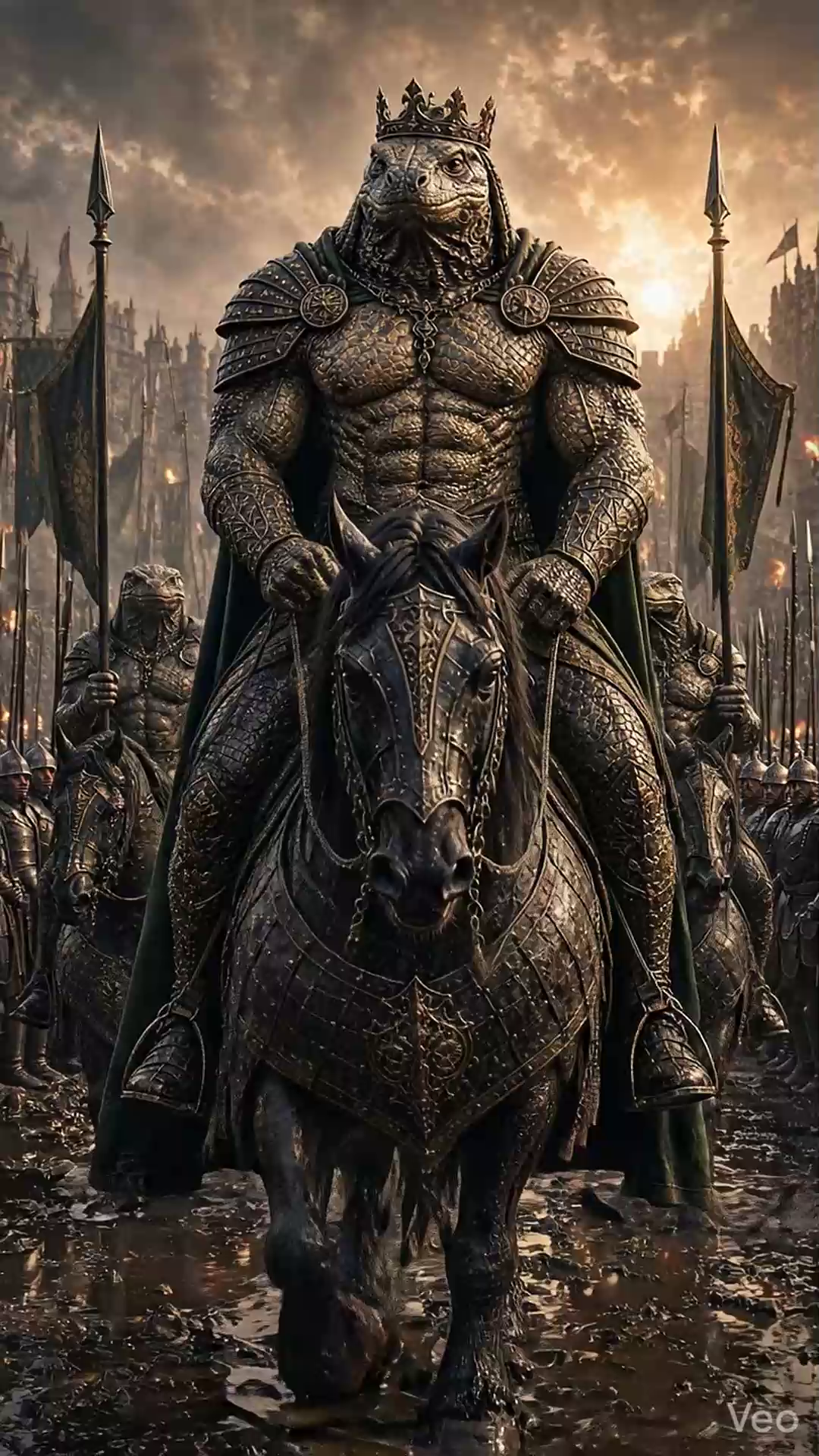
The fortress gate opened while the sun was still hidden behind smoke. First came the black horse, enormous beneath plates of dark armor, each plate edged with old gold and wet with morning rain. Steam moved from the animal's nostrils. Chains along its bridle clicked softly with every step. It did not toss its head or fight the reins. It knew the rider above it, and that knowledge had made it still.
The monarch sat high in the saddle, crowned and massive, his gray scaled body shining like carved stone under the dawn. His chest was bare beneath open war armor, broad with muscle and old scars. Gold ornaments rested against scales thick enough to turn a knife. A deep green cloak fell from his shoulders and dragged near the horse's armored flanks, dark with rain and mud at the hem.
Behind him rode two royal guards of the same Komodo blood. They were smaller than their king only because every living creature was smaller than their king. Each carried a long spear upright in both clawed hands, and the blades rose above the horsemen like judgment held in reserve. They did not look at the crowd of soldiers. Their eyes stayed forward, on the road and on the monarch who had chosen it.
The enemy had crossed the marsh border four nights earlier. They did not come with clean banners or formal demands. They came with fire, rope, and knives in the fog. They burned the oath house at Tarren Ford. They broke the bridge wardens and left the royal seal buried in ash. Refugees reached the fortress road with smoke in their clothes and stories that made the youngest recruits stop pretending war was a song.
The council had asked for delay. Councils are built to ask for delay. They spoke of weather, supply carts, uncertain scouts, and the value of waiting for a stronger hour. The Komodo Dragon War Monarch listened from the end of the hall until the torches burned low. Then he placed one claw on the map at Tarren Ford and said the army would form before sunrise. No one asked what would happen if the army was not ready.
Now the army was ready, and readiness looked nothing like courage. It looked like men standing very still in the mud, trying not to think of the burned oath house. It looked like horses breathing white steam into the dark. It looked like banners hanging heavy because even the wind seemed reluctant to move before the monarch did.
The black horse entered the corridor between the ranks. Hooves pressed into the flooded road with slow, deliberate weight. Soldiers lowered their spears as he passed, not because a herald commanded it, but because the sight of the monarch made ceremony unnecessary. Some bowed their heads. Some bent one knee into the mud. A few stared straight ahead with faces so pale they looked carved from the same dawn as the fortress walls.
The monarch did not raise a hand. He did not promise victory. He did not call the enemy cowards or name the dead or speak the shining lies that make battle easier to enter and harder to survive. His silence moved over the army like a second weather. It told each soldier that war had already been weighed, that excuses had already been buried, and that the road ahead would not ask whether anyone felt brave.
A young archer near the left rank saw the monarch's eye pass over him and forgot the cold. He had joined for coin, bread, and the hope that border trouble would stay at the border. Now the ruler of the realm moved within arm's reach, so large that the horse beneath him seemed part of a moving fortress. The archer understood then that kings were not distant because they were soft. Some kings were distant because seeing them close made obedience feel like something physical.
The two guards followed several paces behind. Their horses stepped into the prints left by the monarch's mount, one on the left and one on the right, spears steady despite the mud. They were not decorations. Every officer on the road knew those guards had carried orders through broken passes and watched traitors kneel in ruined courtyards. If they rode behind the monarch today, the choice had already left the council chamber and entered the world.
At the last gap in the ranks, the Komodo Dragon War Monarch slowed. The entire army seemed to lean toward him. Rain clicked against helmets. Mud breathed beneath hooves. Far ahead, beyond the fortress road, the marsh country waited with its burned bridge, its ruined oath house, and the enemy that had mistaken distance for safety.
Still he said nothing.
That was what the veterans would remember. Not a speech. Not a banner snapping at the perfect moment. Not a promise that the gods had chosen their side. They remembered the silence because silence could not flatter them. It forced every soldier to hear the truth beneath the armor: the crown had come to look at them, and now they had to decide whether they could look back.
Then the black horse moved again. The guards followed. The first rank stepped forward into the hoofprints, then the second, and then the road that had waited all morning began to fill with steel, breath, wet leather, and the low thunder of men choosing motion because stillness had become a deeper fear.
By midday, the fortress would be gone behind them. By night, the marsh would hear the first horns. But the soldiers who survived would not begin the story with the battle. They would begin with the dawn road, the lowered spears, the black horse, and the crowned Komodo Dragon War Monarch riding through the army before the banners moved.