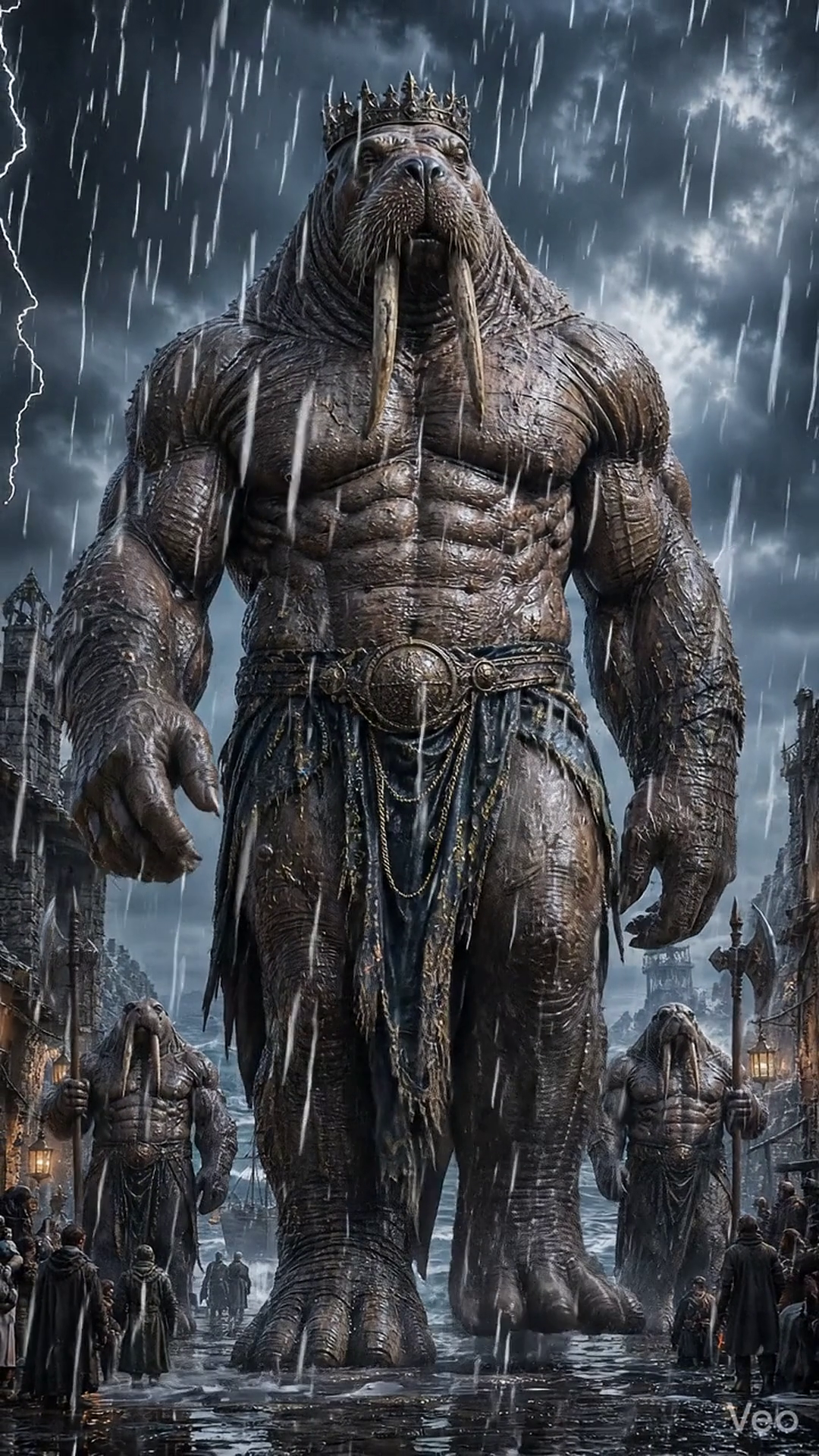
The Walrus King entered the storm harbor village with two armed guards behind him. The sea was already at the doors, but his crown made the whole harbor remember who held back the deep.
This chapter is presented as a complete written tale with curated scene artwork from the realm archive.
The harbor village of Brinemouth had always sounded like two worlds arguing. On calm mornings, gulls cried above the roofs and fishmongers shouted prices from beneath striped canvas awnings. On storm nights, the sea shouted louder than all of them, slamming itself against the outer stones until every house shook on its beams.
The people of Brinemouth liked to say they were born from salt. Their children learned to row before they learned to write. Their elders could smell a bad tide before clouds appeared. Every family owned rope, hooks, oilcloth, and at least one story about a grandfather who had stood on the pier during a storm and laughed at the waves.
But courage was not what kept Brinemouth alive. The Walrus Crown did.
Long before the village became rich from cod, pearl shell, black kelp, and northern amber, the first Walrus King had raised the harbor wall. He sent stone haulers into freezing water with chains around their waists. He sent engineers to carve tide gates from ironwood. He sent guards to stand through winter floods while the village slept behind shuttered windows.
In return, Brinemouth swore a simple oath. The harbor bell would ring at every royal tide. The old crown marker would remain above the sea gate. Each season, the village would send coin, timber, and strong hands to maintain the wall that held the deep away from their doors.
For many years, the oath was kept because everyone remembered the cost of forgetting. Then prosperity softened the memory. The boats grew larger. The market square widened. Merchants from inland cities began calling Brinemouth a free harbor, and the phrase pleased the elders more than it should have.
The first argument came during a late-summer council. Why should a village that fed half the coast bow to a crown that lived beyond the fog banks? Why should their sons repair royal tide gates when their own boats needed mending? Why should an old bronze walrus face stare down from the sea gate when Brinemouth had its own crest, its own guilds, its own proud name?
Pride rarely arrives with a sword. It arrives with accounting ledgers.
By winter, the tribute was delayed. By spring, the harbor bell was rung only on market days. By the next storm season, the bronze crown marker was taken down from the sea gate and placed in a net shed beneath cracked floats and coils of wet rope. The elders replaced it with a painted board showing three silver fish beneath a red tower.
The villagers cheered when the new crest rose. The sea did not.
For seven nights after that, the tide climbed higher than the old men expected. Water licked the bottom steps of the square. Fishing boats knocked against their moorings like nervous teeth. The tide gates groaned in the dark, and the repaired places in the wall sweated streams of cold water. Still, the elders told everyone there was no danger. Storms had always sounded worse than they were.
On the eighth night, lightning split the sky above the harbor mouth, and the western tide gate opened without a hand touching it. Not fully. Just enough for the sea to breathe through. Every lantern in the village bent toward the water at once.
Then two halberds appeared beneath the gate arch.
The royal guards entered first. They were walrus warriors, smaller than their king but broad as dock beams, with tusks capped in dark metal and wet armor shining in the rain. One walked behind-left, one behind-right, both holding long halberds upright while seawater ran from their blades. They did not push the villagers aside. The villagers moved because their bodies understood what their pride had refused to learn.
Behind them came the Walrus King.
He filled the road as if the sea itself had taken a crowned body. His tusks hung like pale spears from a stern animal face. Rain sheeted across his folded hide. His bare chest was massive, marked by old scars, salt, and royal chains. Each step struck the flooded cobblestones with a weight that made water leap around his feet. The two armed guards kept their places behind him while the crowd pressed itself against doorways, barrels, and stone walls.
No herald announced him. No drumbeat called the village to attention. The storm did that work. Thunder rolled over the roofs, lanterns shook, and the harbor bell began to move in the tower though no rope was pulled.
Elder Maeran came forward wearing the new fish-and-tower crest over his cloak. The rain had turned the red paint down the board behind him into thin streaks, as if the village symbol were already bleeding into the gutter. He bowed low and spoke of repairs delayed by poor trade, of young workers taken by fever, of the hardship of maintaining royal gates while storms grew stronger each year.
The Walrus King listened. His guards stood behind him with halberds steady. The villagers heard the sea breathing through the partly open gate, in and out, in and out, like some enormous thing waiting for permission.
When Maeran finished, the king turned his head toward the sea wall. That was all. He did not roar. He did not threaten. He only looked at the stones his crown had raised, and every person in Brinemouth followed his gaze. They saw the cracks they had ignored. They saw the dark water pushing through the seams. They saw how thin the line was between village and deep.
The judgment was spoken quietly enough that only the front rows heard it, but the words traveled through the crowd faster than thunder. The bronze crown marker would be restored before dawn. The tide gates would be repaired by every guild that had voted to neglect them. For one full storm season, Brinemouth would send watchers to stand beside the royal guards at the sea gate, not as punishment alone, but as memory made into labor.
Maeran asked what would happen if the village refused.
The Walrus King lifted one massive hand and pointed toward the open gate. A wave struck the wall at that moment, high enough to spill white water over the arch and down the stones. It ran through the street around the elder feet. It filled the silence better than any answer could have.
Before midnight, the net shed was opened. Men dragged out the bronze walrus marker and cleaned fish oil from its surface with their sleeves. Women brought hammers, ladders, and lantern hooks. Children watched from upper windows as the old crown face rose again above the sea gate, heavier than the painted board, older than the council, and suddenly much harder to mock.
The Walrus King remained in the rain until the final pin was driven into stone. His two guards stood behind him, halberds upright, tusks bright in the lantern glow. The villagers did not cheer. They worked. By dawn, the harbor bell rang for the royal tide, and the sound moved across the water like an apology.
Years later, Brinemouth still called itself brave. That was allowed. But every child also learned the other truth. A harbor may be proud of its boats, its markets, and its salt-born people, but pride does not hold back the sea. Stone does. Oaths do. And sometimes, when the tide rises too high, a crowned Walrus King walks through the storm to remind a village what keeps it alive.