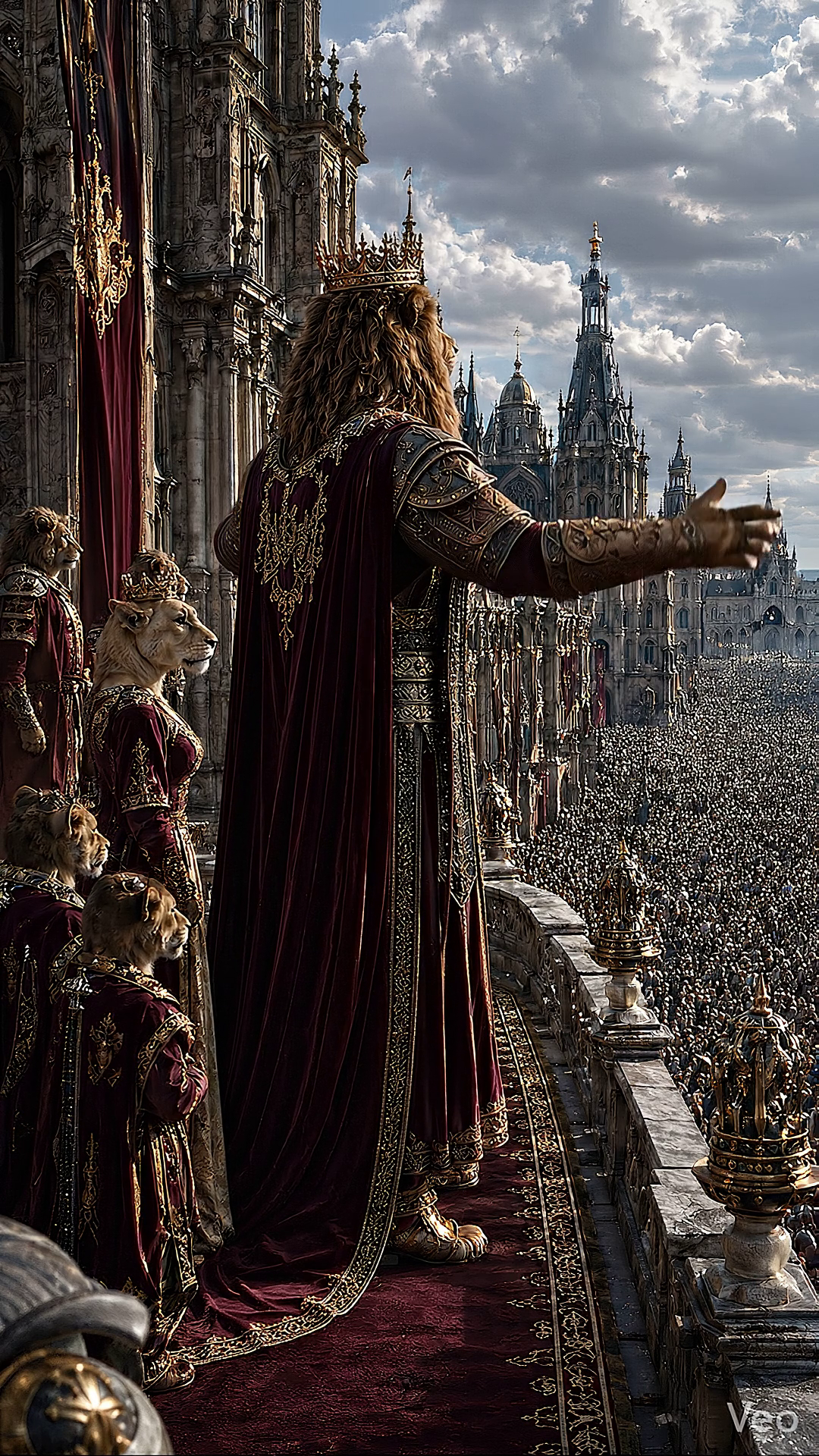
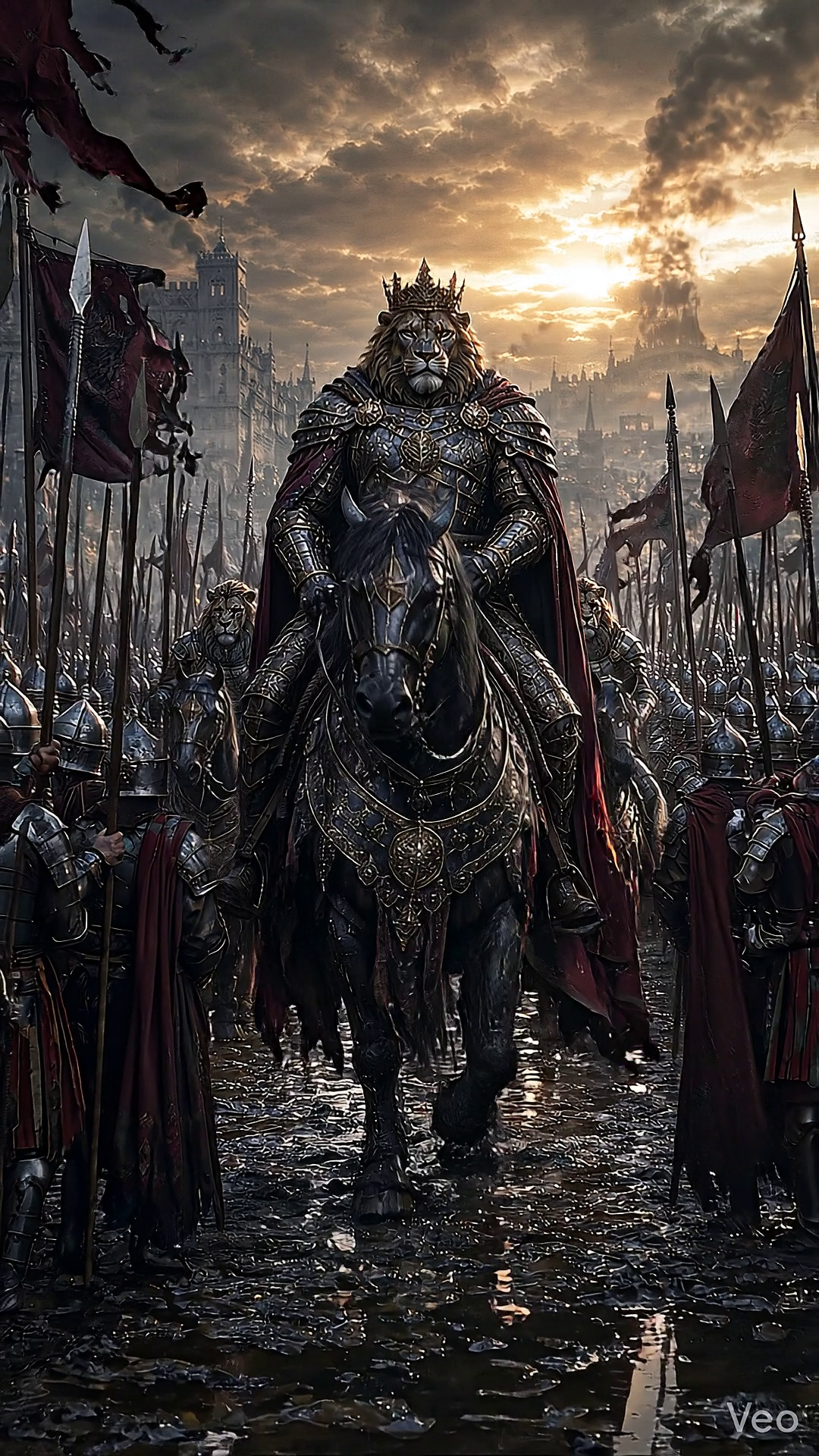
The army did not cheer when he entered the road between them. They lowered their spears. They bent their knees. And the crowned leonine war monarch rode forward in silence. Behind him came two guards of the same bloodline. Ahead of him waited a war that had already taken too many sons. No speech. No mercy. Only hooves in the mud before the banners moved.
This chapter is presented as a complete written tale with curated scene artwork from the realm archive.
The army had been waiting since before sunrise. It filled the low road beneath the fortress walls in two long ranks of steel, leather, torn red banners, and breath steaming in the cold dawn. No one had ordered the soldiers to speak softly, but they did. Men who had shouted through sieges and laughed beside campfires now murmured as if they stood inside a temple. Some tightened straps that were already tight. Some wiped rain from helms that would only be wet again. All of them kept looking toward the northern gate.
Beyond that gate, the royal stables had been open since night. The black war horse was brought out under lantern light, its armor polished dark enough to drink the fire from the torches. Grooms moved around it carefully. Not because the beast was wild, but because it seemed to understand the hour. It stamped once in the mud, and the sound carried down the courtyard like a small warning.
When the crowned leonine monarch mounted, the courtyard changed. He was immense even before the armor, broad enough to make the saddle look like part of a throne. Gold caught along the edges of his black steel plates. His burgundy cloak hung heavy from his shoulders, already darkened at the hem by wet stone. The crown above his mane was not ceremonial today. It had been hammered into the shape of command, sharp points rising like the teeth of an old law.
Two guards rode behind him, smaller only by comparison. They were leonine warriors of the royal bloodline, armored in the same dark metal, each carrying a lance with a red pennant bound beneath the blade. They had followed him through border fires, through a winter famine, through the long rebellion in the western keeps. They knew the meaning of the silence around him. Their lord had already made the decision. The ride was not for counsel. It was for witness.
The northern gate opened without trumpet or drum. The first soldiers saw the horse before they saw the rider, a black shape moving through the mist, plated in steel and gold. Then the monarch entered the road between them, and a line of men who had faced cavalry charges and siege towers lowered their eyes. Not from shame. From recognition. A ruler can stand above an army and give orders, but a different thing happens when he rides through it slowly enough for every soldier to see his face.
The hooves struck mud with a heavy rhythm. Spears leaned inward. Banners snapped and cracked in the wind. The monarch did not raise a hand. He did not call out to them. His silence made the army listen harder than any speech could have. Each soldier understood that he was being counted. Each soldier understood that the crown had come down from the balcony and entered the same road that would carry them toward battle.
The war had begun as a border dispute, or so the court scribes would later write. But everyone in the ranks knew better. Disputes do not empty villages. Disputes do not leave children sleeping in granaries because their houses have been burned for winter fuel. Disputes do not send mothers to the fortress gate with strips of cloth tied around their wrists, begging captains to identify sons who had not come back from patrol.
This was no longer a dispute. It was the shape a kingdom takes when it has been wounded too often to pretend that patience is wisdom. The enemy beyond the eastern marshes had broken three oaths, cut two trade roads, and hanged the last messenger from a dead oak with the royal seal still warm in his pouch. After that, the council had argued for three days. The monarch had listened for two. On the third, he stood and left the chamber.
Now he rode through the army he had chosen to spend. That was the truth beneath the grandeur. Every helm beside him was a life with a mother, a brother, a debt, a field, a secret fear. A lesser ruler would have hidden from that knowledge and sent orders from a warm hall. This monarch rode slowly because he wanted the weight of every face. If he was going to command them into the mud, he would not pretend they were numbers.
A young soldier near the front rank lost his grip on his spear. The shaft dipped too far into the road. One of the royal guards turned his head, but the monarch lifted two fingers from the reins and the guard stilled. The young soldier froze, waiting for punishment. Instead, the horse passed within arm length of him, and the monarch looked down only once. There was no kindness in the look, but there was something harder and more useful. Recognition.
By the time the procession reached the center of the army road, the low murmur had died completely. The only sounds were hooves, chain, leather, wet banners, and the distant drums beginning somewhere near the rear companies. The fortress behind him burned gold in the dawn. The road ahead vanished into smoke. For one moment the whole realm seemed held between those two things: the stone that had protected them, and the war that would decide whether protection had become a cage.
The monarch stopped at the last gap between the ranks. He turned the horse slightly, enough for both lines to see the crown and the scar beneath his left eye. Still he did not speak. He looked across the army, from the oldest captains to the newest shield-boys, and let the silence finish its work. Men straightened. Spears lifted. Knees locked beneath armor. Fear did not vanish. It never does. It merely found a place to stand.
Then the black horse moved again, and the army moved after him. Not all at once. First the drums. Then the banners. Then the front rank stepping into the prints his horse had made in the mud. That was how the campaign began, not with a shouted promise of victory, but with a crowned warrior riding through the people who would pay for it.
Years later, songs would claim he gave a speech that morning. They would invent lines about glory, vengeance, and destiny because songs prefer words to silence. The veterans corrected them whenever they could. They said the monarch had said nothing, and that was why they remembered it. A speech can be misquoted. Silence leaves every man alone with the truth.
The truth was simple enough. A kingdom at war is not carried by banners or crowns. It is carried by the ones who step forward after seeing exactly what the road demands. On that dawn, beneath the fortress and the red torn flags, the army saw its ruler enter the same mud as everyone else. Then it followed.