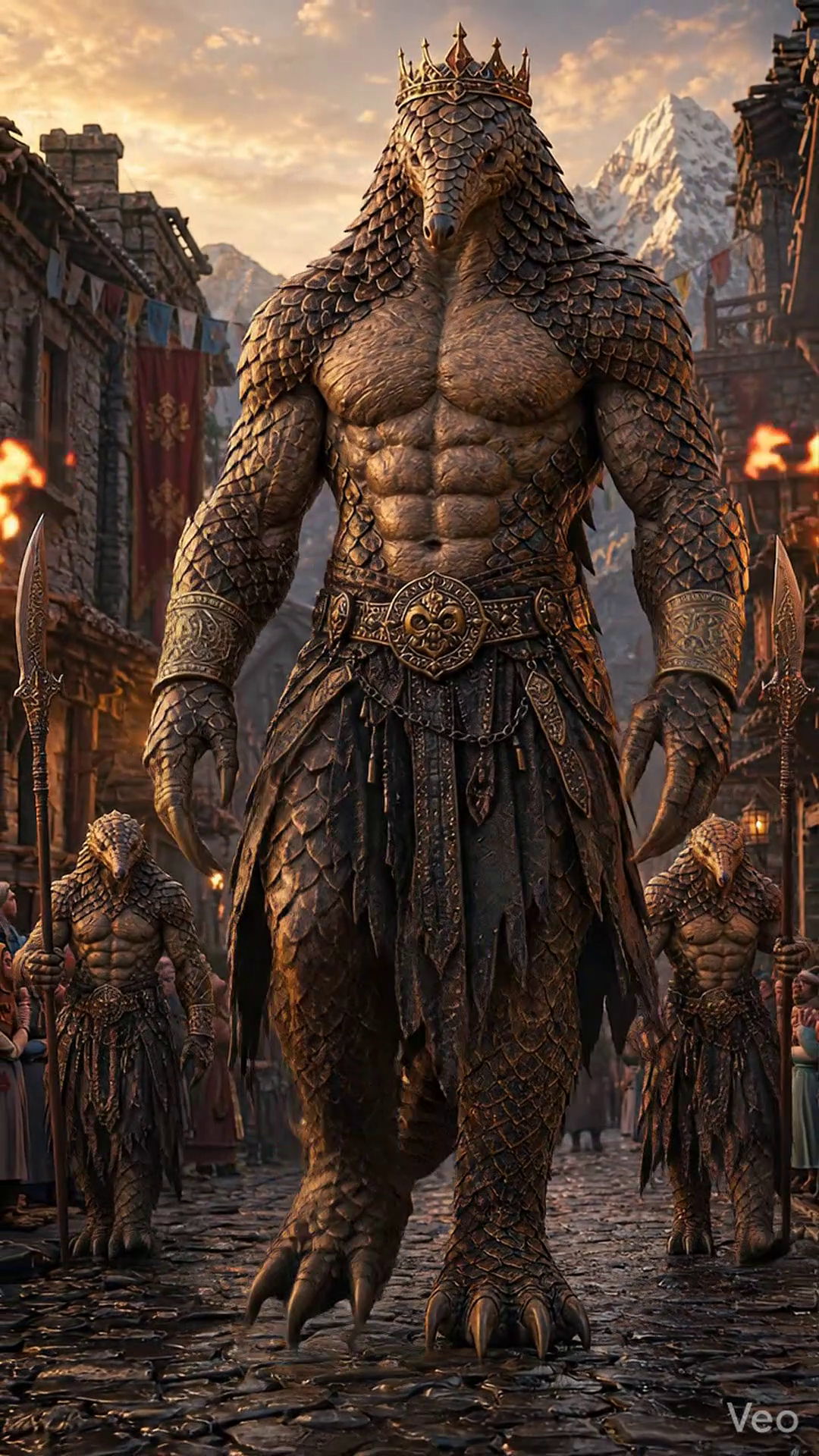
The Pangolin King walked into the mountain village with two armed guards behind him. He was taller than the gate, heavier than the bells, and silent enough to make every oath in the village sound guilty.
This chapter is presented as a complete written tale with curated scene artwork from the realm archive.
The village of Kharven Ridge had been built where the mountain road narrowed between cliffs of blue stone. Every wagon that crossed the pass had to enter its gate. Every shepherd who drove goats down from the high meadows had to stop at its well. Every traveler who survived the winter road learned the same old sentence carved above the arch: the pass stands because the Scale Crown keeps it open.
In the first years, no one questioned the sentence. The snow came too early, the avalanches came without warning, and raiders from the northern scree fields used the fog like a door. It was the Pangolin King's soldiers who cut the first safe steps into the ice. It was his masons who braced the road with iron hooks and black timber. It was his guards who stood under falling sleet while merchants hurried through with lanterns held in shaking hands.
Protection became ordinary, and ordinary things are the easiest to disrespect.
Kharven Ridge grew rich. Its lower market filled with salt, wool, amber, copper kettles, and mountain wine. New balconies leaned over the main road. Banners were hung from roof to roof. The elders began to speak of themselves as a free village with a proud road, as if pride had ever held back snow, hunger, or knives in the dark.
The first missed tribute was explained as a late thaw. The second was blamed on broken ledgers. The third was not explained at all. Then the village removed the bronze pangolin seal from the tollhouse and replaced it with a local crest painted in bright red. The elders toasted their courage that night in the upper hall while the old seal lay face down in a storage room beneath sacks of barley.
Three days later, the mountain bells rang without a hand touching them.
People came out into the road because bells in Kharven Ridge had only three meanings: fire, avalanche, or crown business. No smoke rose from the roofs. No snow came down from the peaks. At first the road beyond the western gate looked empty. Then the crowd saw two spear points moving above the stone wall, slow and steady, like the tips of a law returning from exile.
The guards entered first. They were pangolin warriors of the Scale Crown, smaller than their king but still broader than the village gatekeepers who stumbled backward to let them pass. Their bodies were covered in overlapping bronze-brown plates. Their long snouts stayed lowered beneath iron helms. Each carried a spear upright in both clawed hands, the blades catching firelight as they moved.
Behind them came the Pangolin King.
He was so tall that the crowd first tried to make him into a trick of distance. Then he stepped under the arch and the trick became impossible. His crown passed beneath the carved stone with barely a hand's width to spare. His bare chest was massive, scarred, and ridged with muscle beneath the edge of his scales. A heavy tail dragged over the wet road behind him. Each clawed footfall made water jump between the cobbles.
No herald announced him. No horn tried to dress the moment in ceremony. The king's silence did more. It moved through the village faster than a command. Bakers stepped back from their stalls. Children were pulled behind cloaks. Men who had laughed at the old tribute lowered their eyes as if the stones might report them.
Elder Varric came forward because someone had to stand where the village's courage had been loudest. He wore the red sash of Kharven Ridge, the new crest stitched in gold across his chest. He bowed with the careful measure of a man trying to show respect without admitting defeat. The Pangolin King looked down at him, and the elder seemed to shrink without moving.
Varric began with weather. The winter had been long. The pass had been expensive to repair. The village had carried burdens that distant rulers could not understand. Perhaps the tribute had been delayed, he said, but never denied. Perhaps the seal had been removed only for cleaning. Perhaps the king had been misinformed.
The Pangolin King did not answer him at first. His gaze moved past the elder to the tollhouse, where the fresh red crest hung where the bronze pangolin seal had always watched the road. That was the insult. Not hunger. Not hardship. Not delay. The village had not merely withheld payment. It had tried to keep the road and erase the hand that held it open.
At last the king raised one claw. His guards stopped behind him, spears still upright. The whole market stopped with them. Torches cracked along the eaves. Somewhere high above the village, snow shifted on a roof and slid down in a soft white sheet.
The king's judgment was not shouted. Kharven Ridge would restore the bronze seal before sunset. The tollhouse would open again before dawn. Half the missing tribute would be forgiven because the winter had truly been cruel. The other half would be paid in labor on the high road, repairing the barriers, clearing ice, and standing watch in the same storms the crown's soldiers had faced for generations.
Varric asked what would happen if the village refused.
The Pangolin King looked toward the cliffs above the western road. Every villager followed his gaze. They knew those cliffs. They knew where the stones fell, where fog gathered, where old bones still worked their way out of the snow after spring rain. The king did not threaten to burn the village. He said only that a road abandoned by its oaths becomes a wilderness again, and wilderness keeps no market alive.
No one called that mercy. Not while the guards stood armed behind him. Not while the huge crowned figure filled the road like a mountain given breath. But by nightfall, men were carrying the bronze seal back to the tollhouse. Women brought lanterns. Children watched from doorways as the old pangolin face was lifted into place above the arch.
The Pangolin King remained until the final nail was driven. Then he turned toward the western gate, his tail scraping stone, his guards falling into step behind him. He left Kharven Ridge with no cheer, no blessing, and no promise that he would come gently a second time.
Years later, when storms closed the pass and travelers begged for shelter, the villagers still pointed to the bronze seal above the road. They told the story in lowered voices, not because they hated the Pangolin King and not because they loved him. They told it because every mountain child needed to know the truth Kharven Ridge had learned too late: a village may forget an oath, but the road remembers.