Karath was supposed to be empty after the first clash. The armies had pulled back. The fires had burned low. The broken standards had stopped moving except when the wind found them. Then the Scorpion King stepped onto the cracked road again. He did not walk like a victor. He walked like a ruler measuring the price of every command that had brought his kingdom here.
Karath was quiet only from far away. From the western ridge, where the surviving captains had gathered beneath torn black banners, the battlefield looked almost still. Smoke stood in low folds between the broken columns. Fires shivered in old braziers and ruined carts. The cracked road that had divided two kingdoms before dusk was now covered with dust, splintered spear shafts, shattered shields, and footprints crossing over footprints until no soldier could tell which side had advanced and which side had fallen back.
The Scorpion King had ordered the lines to hold before dawn. That command saved lives, though not enough of them to feel like mercy. The first clash had not become the full war his youngest generals wanted. It had become something colder: a warning written in bodies, broken metal, and the silence of men who had shouted themselves hoarse and now had nothing left to say. Karath had shown both armies what pride could buy. Neither kingdom had enough treasure to pay the rest of the price.
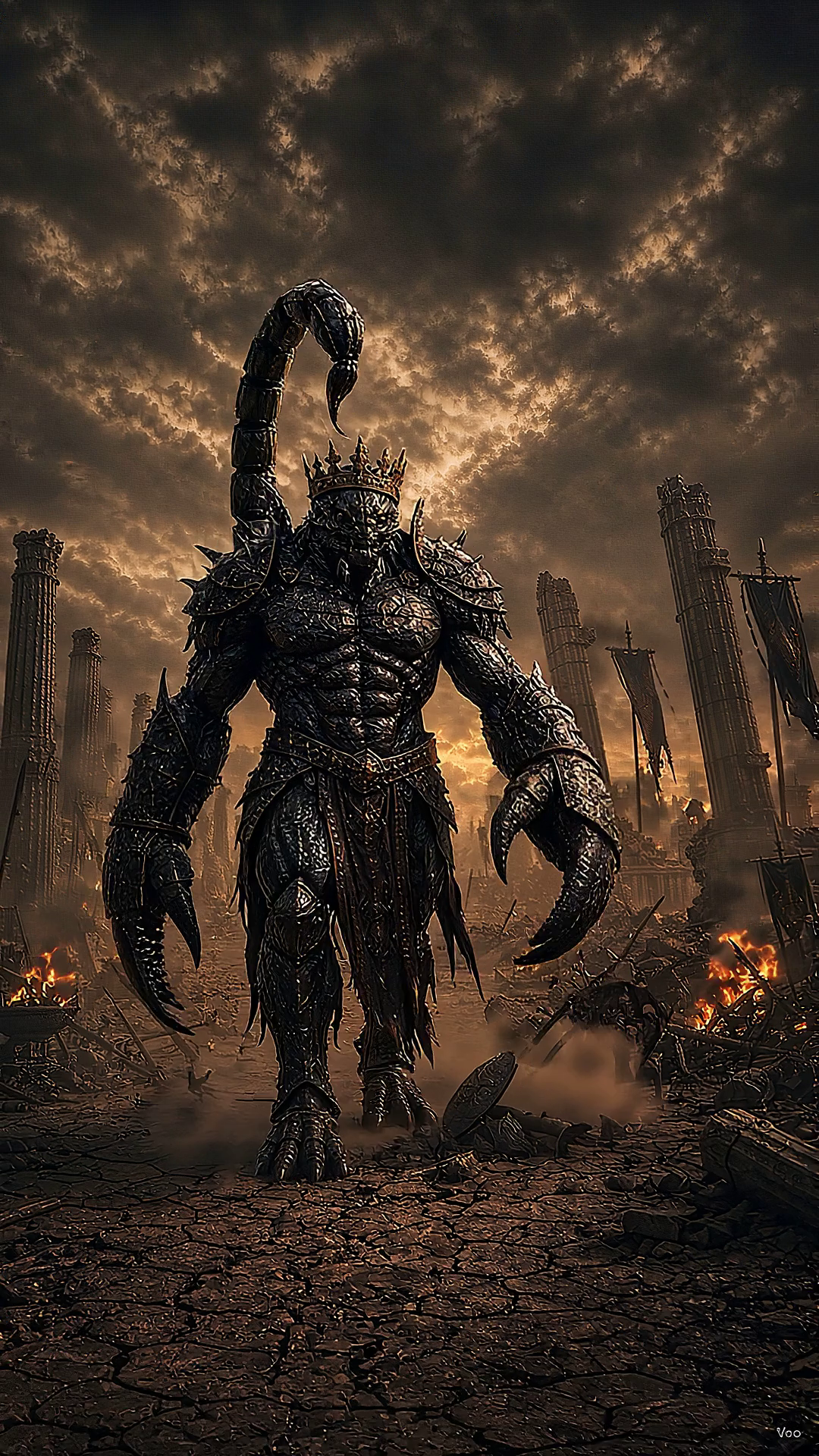
His ministers advised him not to walk the field. They said assassins could still be hiding among the fallen columns. They said eastern scouts might read weakness in the sight of a monarch alone. They said the court needed him visible on the ridge, surrounded by guards and torches and the old symbols of command. The Scorpion King listened without looking at them. Then he stepped past the banners and descended toward the road by himself.
No guard followed. They knew better than to mistake solitude for vulnerability. His black chitin caught the bronze storm light, each plate marked by ash and the fine pale dust of Karath. The gold of his crown seemed less bright than it had before the clash, not because it had dimmed, but because everything around it had burned. His pincers hung low at his sides. His tail rose behind him in a slow, balanced arc, not threatening, not resting, simply present, the way old law remains present even when no one speaks it aloud.
The first thing he passed was a shield from his own western shelves. Its black face had been split by a horned strike, and the royal mark had been scraped almost clean. Beside it lay an eastern banner pole, snapped in three places, the horn crest blackened at the edges. The two objects should have been enemies. On the ground they looked like pieces of the same mistake. The Scorpion King stopped long enough to turn the shield with one claw and saw that the inside strap had been repaired by hand, carefully, more than once. Some soldier had expected to carry it home.
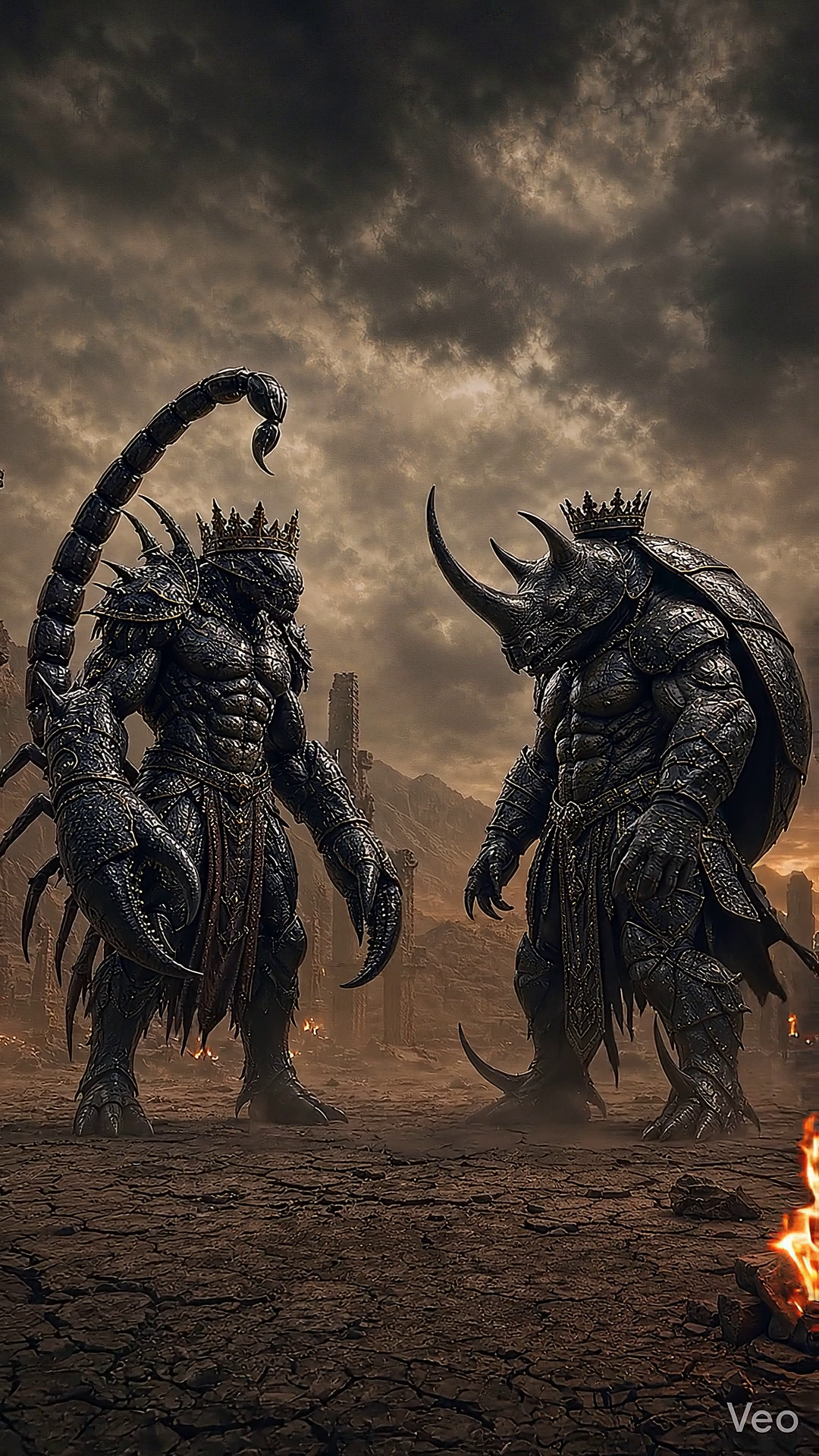
He kept walking. Dust curled around his feet. Small fires cracked in the broken wagons. A torn strip of red cloth lifted from a spear point and twisted in the wind like a warning that could no longer choose a language. Far away, the eastern army had also fallen back. Their horns and armor were only dark shapes beyond the ruins, but he could feel them watching. He knew the Rhinoceros Beetle King would hear about this walk before sunrise. Perhaps the horned ruler would call it theater. Perhaps he would understand it as inquiry. Perhaps he would come to the road himself.
Karath had always been more than stone. That was the danger of it. The dead city sat where trade roads met, where salt from the west crossed iron from the east, where copper, grain, water rights, and pride all wore the disguise of necessity. Court scribes could make the war sound inevitable by arranging those words properly. Salt. Iron. Tribute. Passage. Security. Honor. A ledger can make hunger look like policy and fear look like strategy. But the battlefield was less polite. It showed him the cost without columns or seals.
He remembered the burned caravan at the fifth column, the evidence placed too neatly in ash, the beetle crest found where a beetle spy would never have left it, the black stingers arranged with the careful stupidity of someone who wanted anger to outrun thought. He had known, before the clash, that the signs might be false. He had known it and still marched. That was the thought that followed him down the road more closely than any guard could have done.
A ruler does not need certainty to make war. He needs pressure, insult, frightened advisers, ambitious generals, hungry merchants, and enough wounded pride to make hesitation look like cowardice. The Scorpion King understood every one of those forces because he had used them against other courts. Now they had been used against him, and the lesson tasted of iron. Someone beyond the two crowns had moved the pieces. Someone had trusted that kings would rather answer an accusation than question why it arrived so perfectly shaped.
He reached the center of the battlefield, the same stretch where he and the Rhinoceros Beetle King had stood close enough to strike. The marks were still there. Two deep sets of footprints faced each other in the cracked earth, surrounded by the churned path of the clash that followed. The Scorpion King's pincers opened once, slowly, then closed. He looked east, toward the horned silhouettes beyond the smoke, and understood that the next step could still become either a road or a grave.
Behind him, one of his captains called his name from the ridge and stopped before the second syllable. The king did not turn. Names belonged to courts. Karath belonged to consequences. He lowered one pincer and lifted a broken spear from the dust. It was not western. It was not eastern either. The metalwork was wrong for both armies, too plain for the horned citadels, too heavy for the stinger clans. A small thing. A buried thing. The kind of evidence war teaches men to overlook because blood is louder.
He carried the spear fragment back toward his line as the first gray edge of morning appeared behind the storm. Soldiers watched him pass and tried to read victory in his face. They found none. That frightened them more than triumph would have. Triumph is easy to obey. Reckoning asks harder service.
By sunrise, the Scorpion King sent three orders. No raid would cross the eastern dry river. No caravan road would be sealed until the false signs were traced. Every captured scout, western or eastern, would be questioned for names, not punished for symbols. His generals hated the orders because they sounded like delay. His older captains obeyed them because they heard what delay truly was: the last remaining doorway through which a kingdom might avoid becoming smaller than its anger.
The songs later forgot the spear fragment. Songs prefer claws, crowns, and the moment a ruler fills the road beneath a burning sky. But the scribes who survived Karath wrote a quieter line in the margin of the war ledger: that after the first clash, the Scorpion King walked alone through the field and found proof small enough to fit in one hand. Not enough to end the war. Not yet. Enough to change the next command.
Karath did not become holy after that morning. Nothing so wounded becomes holy simply because kings learn from it. But the battlefield became honest in a way courts rarely are. It kept every mark. It kept the footprints, the ash, the broken banners, and the road between two enemies who had almost let another hand decide their future. And when the Scorpion King crossed it again, he did not walk like a victor. He walked like a ruler who had finally begun counting the dead before counting the insults.