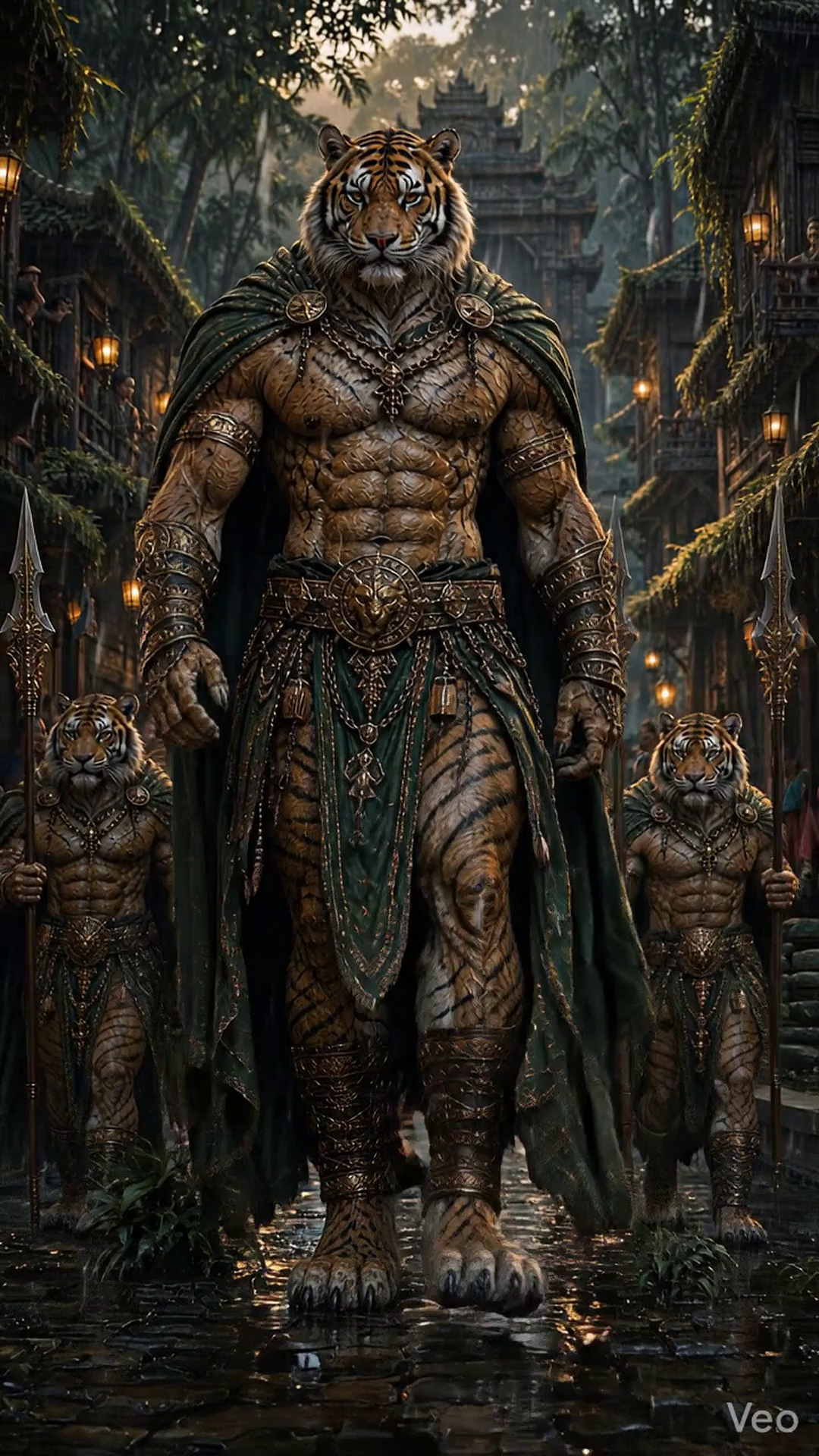
The rain village went silent when the tiger monarch entered the gate. Two armed guards followed behind him. The lanterns shook. The road did not. Some rulers arrive with an army. This one arrived with enough shadow for one.
This chapter is presented as a complete written tale with curated scene artwork from the realm archive.
Rain had been falling on Vael Tajan for three days, soft at first, then steady enough to turn the whole village into a mirror of lantern light. Water ran from the carved temple roofs and spilled down the steps in silver sheets. It gathered between the stones of the main road, where every shop sign, balcony rail, and hanging prayer cloth trembled in the reflection. By dusk, the village looked less like a place built by hands and more like a memory trying not to drown.
No one spoke above a whisper after the western bell rang. The old families knew what the bell meant. It was not used for storms, fires, births, or funerals. It belonged to an older fear, one the younger villagers had learned only as a phrase muttered by grandparents when tax collectors passed through: if the Rain Gate calls, the jungle has remembered you.
The gate stood beyond the market road, half swallowed by vines and older than the temple behind it. It had once marked the entrance to the tiger monarch's protected road, a passage through the wet forest where caravans could move without being taken by bandits, river fever, or the war clans that lived beneath the black cliffs. For generations, Vael Tajan paid its oath-price in rice, bronze, and service. In return, the road stayed open, and the village grew rich from everything that passed through it.
Then prosperity taught the council to mistake comfort for independence. They sealed the tollhouse. They sent the monarch's collectors away with polite lies. They told the children that no ruler from the deep jungle would cross thirty flooded miles to argue over an oath written by dead men. When traders asked why the tiger seal had been removed from the western arch, the council said the old arrangement had simply expired.
Oaths do not expire. They wait.
At the first sound of heavy steps beyond the gate, every window lit and every doorway filled with faces. The villagers expected riders, perhaps soldiers, perhaps an official in lacquered armor carrying a scroll of accusation. Instead, a single colossal figure entered the road on foot. He was taller than the doorframes, broader than the carved pillars of the rain shrine, bare-chested beneath a dark green cloak that dragged water from the air as if the storm belonged to him.
The tiger monarch's fur burned orange and black under the lanterns. Gold chains crossed his chest. Bronze and emerald ornaments shifted at his waist. His eyes stayed fixed ahead, pale and unwavering, while the rain ran down the planes of muscle and armor like it had found a statue that had decided to walk. Behind him came two smaller tiger guards, one to each side, each holding a long ceremonial spear upright in both hands. Their weapons were polished, practical, and very real.
The road did not bend beneath him, though many later swore it had. What it did was remember weight. Each step landed with the patient certainty of a gate closing. Water jumped from the stones. Lantern flames shivered in their glass. A child began to cry near the fish market, and her mother pulled her close without taking her eyes from the monarch.
Councilman Ravan came out beneath a blue umbrella held by a servant whose hands would not stop shaking. Ravan had signed the order to close the tollhouse. He had also ordered the tiger seal buried under the grain office floor, because even rebellion looks cleaner when its symbols are hidden. He bowed with the careful depth of a man measuring how much pride he could afford.
The tiger monarch stopped before him. For a moment the only sounds were rain, distant insects, water rushing from roofs, and the slight scrape of spear shafts in armored hands. The guards did not threaten anyone. They did not need to. Their stillness made the whole road feel narrower.
Ravan spoke first because silence had begun to make him look small. He said Vael Tajan had suffered poor harvests. He said the toll had become difficult. He said the old contracts were unclear, that perhaps the village had misunderstood what was owed and what had merely been custom. The words came out polished and wet, like stones turned over in a river.
The monarch listened until the councilman's voice failed. Then he looked past him to the sealed tollhouse. Moss had grown over the lock. Someone had painted festival flowers where the tiger seal had once hung. That insult drew the first change in his expression, not anger exactly, but recognition. He had not walked through the rain to discover whether the village was hungry. He had come to see whether it was honest.
He told them the protected road had cost more than tribute. It had cost scouts taken by fever, guards lost in ravines, bridge builders swept into floodwater, and young warriors buried without songs because the road still needed watching by dawn. Vael Tajan had grown wealthy behind that sacrifice. If hunger had driven them to plead, the jungle court would have heard them. But they had chosen erasure and called it freedom.
No one answered. Even Ravan lowered his umbrella.
The sentence was given without shouting. The tollhouse would open before midnight. The buried seal would be returned to the arch. The council seats would be emptied for one season and filled by those who had maintained the road with their hands: porters, bridge masons, lantern keepers, and widows of the patrols. The unpaid oath-price would not be taken in grain while the harvest was weak. It would be paid in labor, stone, and repaired bridges along the western marsh.
Some in the crowd hated him for it. Some loved him before they understood why. Most simply watched the huge tiger monarch turn and continue down the rain-bright road, his two armed guards following in perfect silence. He had not conquered Vael Tajan. He had done something harder to forgive. He had made the village remember what it had chosen to forget.
By morning, the tiger seal was back above the Rain Gate. Children would later ask whether the monarch had roared, whether soldiers had filled the streets, whether anyone had fought. The old ones always shook their heads. They said no roar was needed. The rain had been loud enough, and the king had been quiet enough, and every person in the village had heard the oath return.