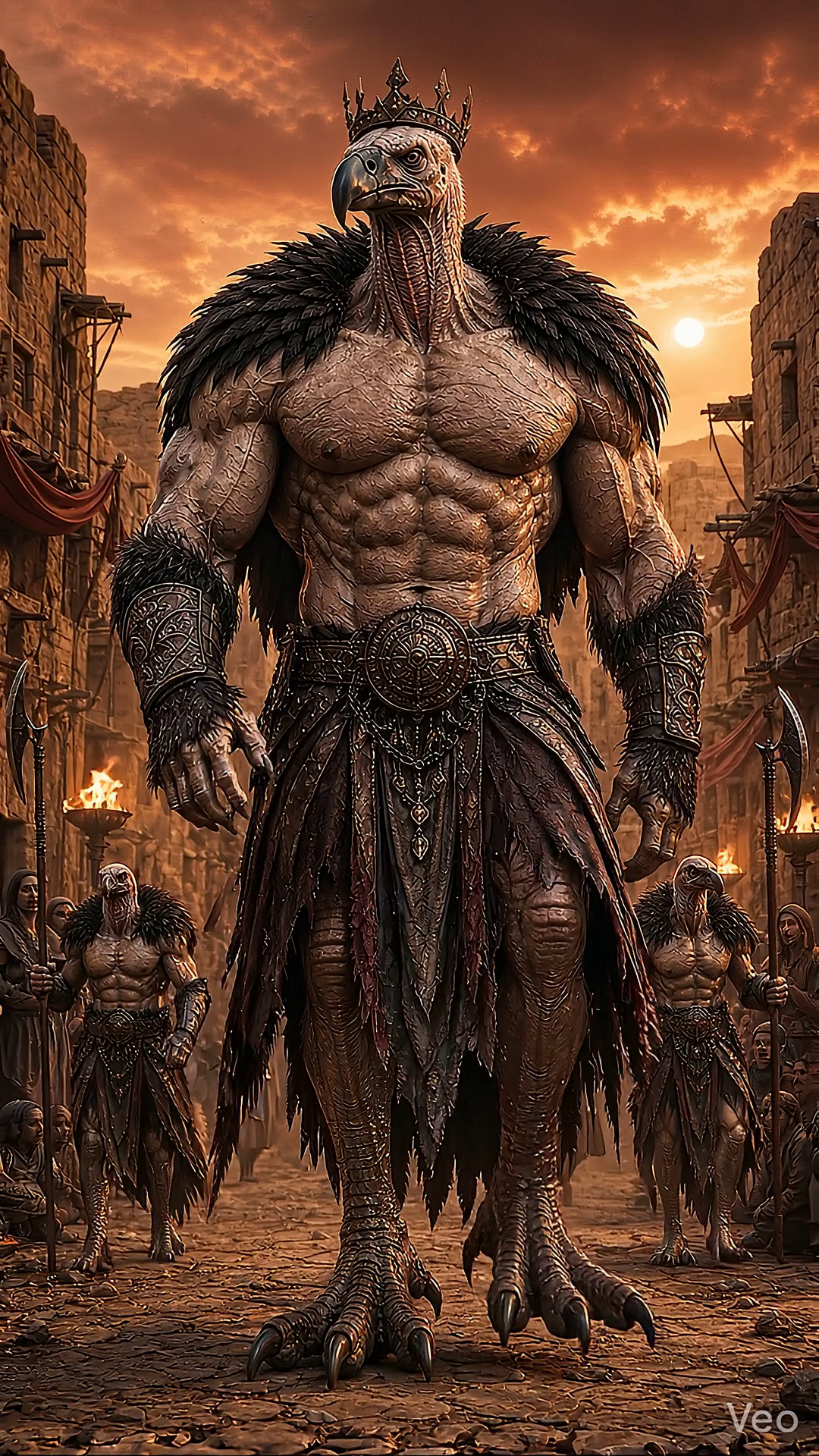
The Vulture King entered the desert village at sunset with two armed guards behind him. The crowd expected a scavenger king. Instead, the road filled with a giant who had come to collect the oath they buried.
This chapter is presented as a complete written tale with curated scene artwork from the realm archive.
The desert village of Harrun Gate was built where the red road crossed the burial flats. Caravans hated stopping there after sunset. The wind moved too strangely over the ash fields, lifting pale dust into shapes that looked almost like hands. Even the camels grew quiet near the old boundary stones. But Harrun Gate had water, shade, and walls high enough to keep raiders outside, so every traveler eventually paid the toll and entered.
The village survived because of an oath older than its market. Long before the sandstone houses rose beside the road, the Vulture Crown had claimed the burial flats as sacred ground. Its warriors guarded the dead from thieves, flame cults, and hungry armies that stripped tombs for bronze and bone. In return, Harrun Gate was allowed to trade beside the flats, draw water from the crown wells, and burn its night braziers under royal protection.
For generations, the arrangement was treated with fear. The villagers left black grain at the boundary stones. The elders bowed when vulture guards passed above the gate. No house was built facing the ash fields without a bronze feather nailed above the door. Children were taught that the dead did not belong to the village, the road did not belong to the village, and the silence beyond the wall was not empty.
Then trade made the village proud.
Salt, copper, glass beads, and blue desert cloth filled the market. Harrun Gate grew fat on travelers who wanted to cross the flats before nightfall. New houses rose higher than the old shrine. Merchants began saying the village protected the road by itself. The young mocked the bronze feather above the gate, calling it a charm for frightened grandmothers. The elders did not correct them because the elders had begun to enjoy the sound of freedom.
The first tribute was delayed. The second was counted short. The third was hidden entirely, buried under a false ledger and a speech about drought. Then the village did the thing no drought could excuse. They removed the Vulture Crown's seal from the western arch and sealed it in a grain cellar beneath sacks of millet, as if stone, bronze, and oath could be made harmless by darkness.
For seven days, nothing happened. That was what made the village bold. Men laughed louder in the market. Women washed red dust from the tollhouse steps. Children played at being kings by wearing feathers in their hair. On the eighth evening, as the sun lowered behind the burial flats, every bird in the village flew east at once.
No one had ever seen that before.
The sky emptied in a single black wave. Pigeons, hawks, crows, and the small dust-colored birds that lived beneath the eaves all fled toward the river country. The villagers looked up until their necks hurt. Then the western gate opened by itself, and two polearm blades appeared in the sunset beyond it.
The guards entered first. They were vulture warriors of the Ash Road, smaller than their king but still taller than the tallest men in Harrun Gate. Their long necks were bare and wrinkled beneath iron collars. Their hooked beaks were motionless. Each carried a curved polearm upright in both taloned hands, and the blades caught the last sun like strips of fire.
Behind them came the Vulture King.
The crowd had expected something stooped, cruel, and thin, because fools imagine carrion birds as weak until the shadow passes over them. The king who entered Harrun Gate was colossal. His bare chest was wide as a gate door, scarred and ridged with muscle. Black feathers rose around his shoulders like a storm cloak. His long vulture neck lifted a crowned head above the awnings, and his taloned feet struck the stone road with a weight that made dust jump from the cracks.
No herald named him. No horn announced him. The villagers knew him because every old story they had laughed at suddenly stood in the street.
Elder Samet came forward with both hands open. He had argued hardest for the village's freedom. He had called the Vulture Crown distant, ceremonial, and half dead. Now he bowed so low that his red sash dragged through the dust. He spoke of hardship. He spoke of trade losses, dry wells, sick children, and the burden of old payments. He tried to make theft sound like survival.
The Vulture King listened without blinking. His guards did not move. The crowd watched the elder's words fall into the heat and vanish. When Samet finished, the king turned his head toward the western arch. The empty place where the bronze seal had hung looked brighter than the stones around it, a clean wound in the village wall.
That was the answer. The king had not come for missing grain. He had come because Harrun Gate had tried to keep the protected road while burying the symbol of the hand that protected it. Hunger could be forgiven. Pride had to be named before it became a law.
His judgment was given in a voice low enough that everyone leaned toward it and terrible enough that no one wished they had heard less. The bronze seal would be restored before moonrise. The buried tribute would be paid, not in grain alone, but in labor on the ash road. For forty nights, the village would send watchmen to the burial flats. They would guard the tombs they had profited beside. They would learn the silence they had mocked.
Samet asked what mercy remained in such a sentence.
The Vulture King looked past him to the walls, the wells, the braziers, and the frightened children pressed against their mothers' robes. Mercy, he said, was that Harrun Gate still had walls to stand behind. Mercy was that the dead had not been left to speak for themselves. Mercy was a king walking through the gate with two guards instead of sending an army over it.
By moonrise, the grain cellar was open. Men carried the bronze seal into the street with ropes around it, ashamed by how heavy it felt. Women brought lamps. Children who had worn feathers in play watched the old symbol rise back above the western arch. No one cheered when the final pin was hammered into place. The sound was too close to a verdict.
The Vulture King remained until the seal caught moonlight. Then he turned toward the burial flats, his guards falling into step behind him. The road swallowed their shadows slowly, one royal footfall after another, until even the braziers seemed afraid to crackle.
After that night, Harrun Gate never called itself free of the Ash Road again. Travelers still came. Merchants still haggled. Children still played beneath the awnings. But when sunset burned red over the burial flats, every voice in the village lowered. They had learned what the old stones meant. A road may feed a village, but an oath is what keeps the village from being eaten by the dark beyond it.