The rain village had locked its gates before sunset. Then the Turtle King entered anyway. He did not hurry. He did not shout. The old stones simply began to shake beneath the weight of a ruler who had crossed flood, mud, and betrayal to reach the people who broke their oath.
The village of Velmire had been built where the river split into three black channels and the hills folded around the valley like closed hands. In the dry months, the place smelled of moss, wet timber, and smoke from fish ovens. In the rainy months, the streets became mirrors, the roofs sagged under water, and every archway seemed older than the people who passed beneath it. The villagers were proud of surviving there. They said stone remembered their names. They said the river obeyed them because their fathers had tamed it with walls, sluice gates, and prayer.
That was not true, but pride rarely asks permission from truth. The river obeyed because the Turtle King's engineers had carved the flood channels generations earlier, and because his patrols kept the northern marsh clans from breaking the levees in winter. Velmire owed him grain, timber, and one oath spoken every new moon at the old river stone: while the channels held, the village would keep the king's road open and shelter any traveler bearing his shell mark.
For forty years, the oath sounded simple. Then the rain changed. It came early, fell hard, and did not stop. Hillsides loosened. Bridges vanished under brown water. Merchants arrived soaked and frightened, carrying stories of wagons overturned in the marsh road and children pulled from flooded fields. Velmire filled its storehouses and barred its gates. When three travelers with the shell mark came begging for shelter, the elders turned them away.
One of the travelers was a messenger. One was a wounded canal mason. The third was a child carrying a copper tube sealed with the Turtle King's crest. The village watch told them the inn was full, though it was not. The elders said fear had made them careful, though it had really made them small. By dawn the three travelers were gone into the rain, and the copper tube had been found in the mud, crushed beneath a wagon wheel.
No army arrived the next day. No horn sounded from the ridge. For a week, Velmire almost convinced itself that the storm had hidden its shame. The elders repaired the gate chain, posted extra watchmen, and told the market that dangerous strangers had been refused for the safety of the village. People believed them because belief is easier when it protects the bread in your own cupboard.
On the eighth evening, the rain thickened until the torches hissed blue at the edges. A tremor moved through the lower street. At first the villagers thought the river wall had cracked. Then they heard the footsteps. Slow. Heavy. Certain. Each one struck the flooded stones like a verdict being hammered into place.
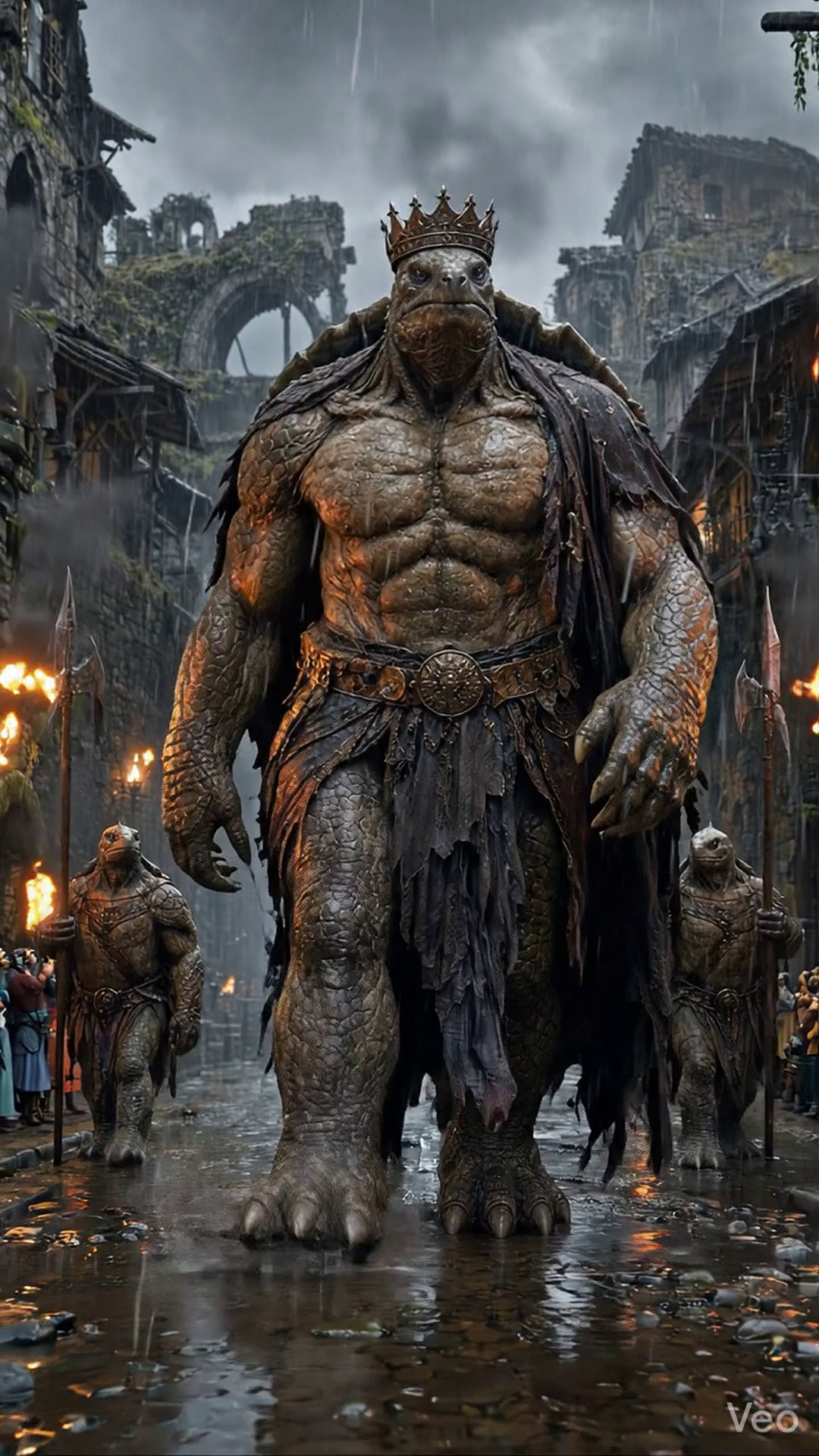
The Turtle King entered through the eastern gate without breaking it. That frightened Velmire more than force would have. The gate had been opened from the inside by the oldest keeper, whose grandfather had helped build the first channel and who still remembered the words of the river oath. Behind the king walked two smaller turtle guards, one to each side, their spears upright, their eyes fixed ahead. They did not threaten anyone. They did not need to.
The king was larger than the stories made him. Rain ran down his crown and over the ridges of the shell rising from his back. His chest and arms were bare, massive, scaled, and scarred by years no human ruler could have carried. Mud splashed around his clawed feet. His cloak dragged behind him like a piece of night torn loose from the storm. He moved slowly, not because he was weak, but because the world seemed obliged to wait for him.
The villagers pressed themselves against walls and doorways. Children stared from under awnings. Men who had sharpened axes in secret lowered their eyes before the guards even reached them. The elders gathered beside the well, wearing ceremonial sashes that looked foolish in the rain. Elder Varro stepped forward and began to explain the danger, the hunger, the river, the rumors of thieves. He spoke for a long time because he was afraid of the silence that would follow.
The Turtle King listened. Water dripped from his jaw. The torches behind him threw warm light over his scales and made the old scars on his arms shine like bronze. When Varro finally stopped, the king lifted one hand. In his palm lay the crushed copper tube. The royal crest had been flattened, but not erased.
No one in Velmire breathed loudly after that. The king asked where the messenger had gone. No answer. He asked who had closed the gate. No answer. He asked whether the wounded mason had been given medicine before being sent back into the flood. Varro looked down at the water around his boots, and that was answer enough.
The judgment was not quick. Turtle kings do not hurry through law. He ordered the storehouse opened and every traveler bearing any road mark fed before the village ate again. He ordered the lower inn emptied for the sick and flooded-out families from beyond the marsh road. He ordered the elders to walk the river wall each night until the storm season ended, not from the safety of the watchtower but ankle-deep in the same water they had sent others into.
Varro protested that the village would starve if it gave too much away. The Turtle King looked past him to the full granary roofs, then to the children watching from the market stalls. He said a village that survives by refusing the desperate has not survived at all. It has merely postponed the day someone stronger arrives to ask what its survival cost.
That night, Velmire opened its gates. The first to enter were not warriors but families from the drowned farms, carrying blankets, broken tools, and sleeping children. The Turtle King's guards stood beside the road and counted them in. The king remained in the square until dawn, still as a carved monument except when another wagon arrived and he turned his head to see whether the oath was being kept.
By morning, the rain had not stopped. The river had not become gentle. The village was poorer in grain, crowded with strangers, and ashamed in a way that would take years to name properly. Yet the lower streets did not feel smaller. They felt wider, as if the gate had been the narrow thing all along. When the Turtle King finally left Velmire, his footsteps faded into the storm, but the old stones kept the memory. Not of his anger. Of his patience. Of the terrible weight of a ruler who came walking through the rain to remind a village that an oath is easiest to praise before it becomes expensive.