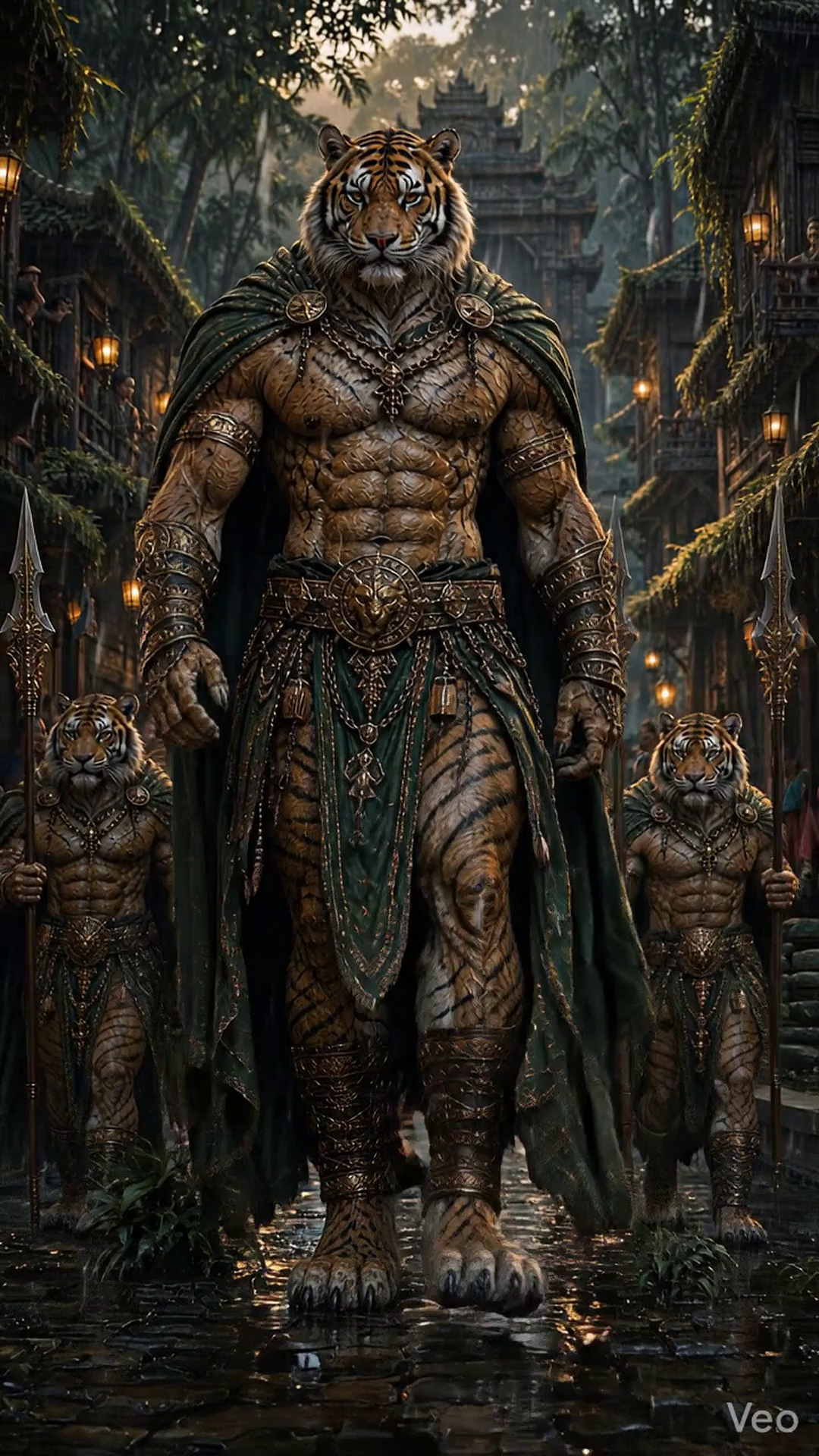
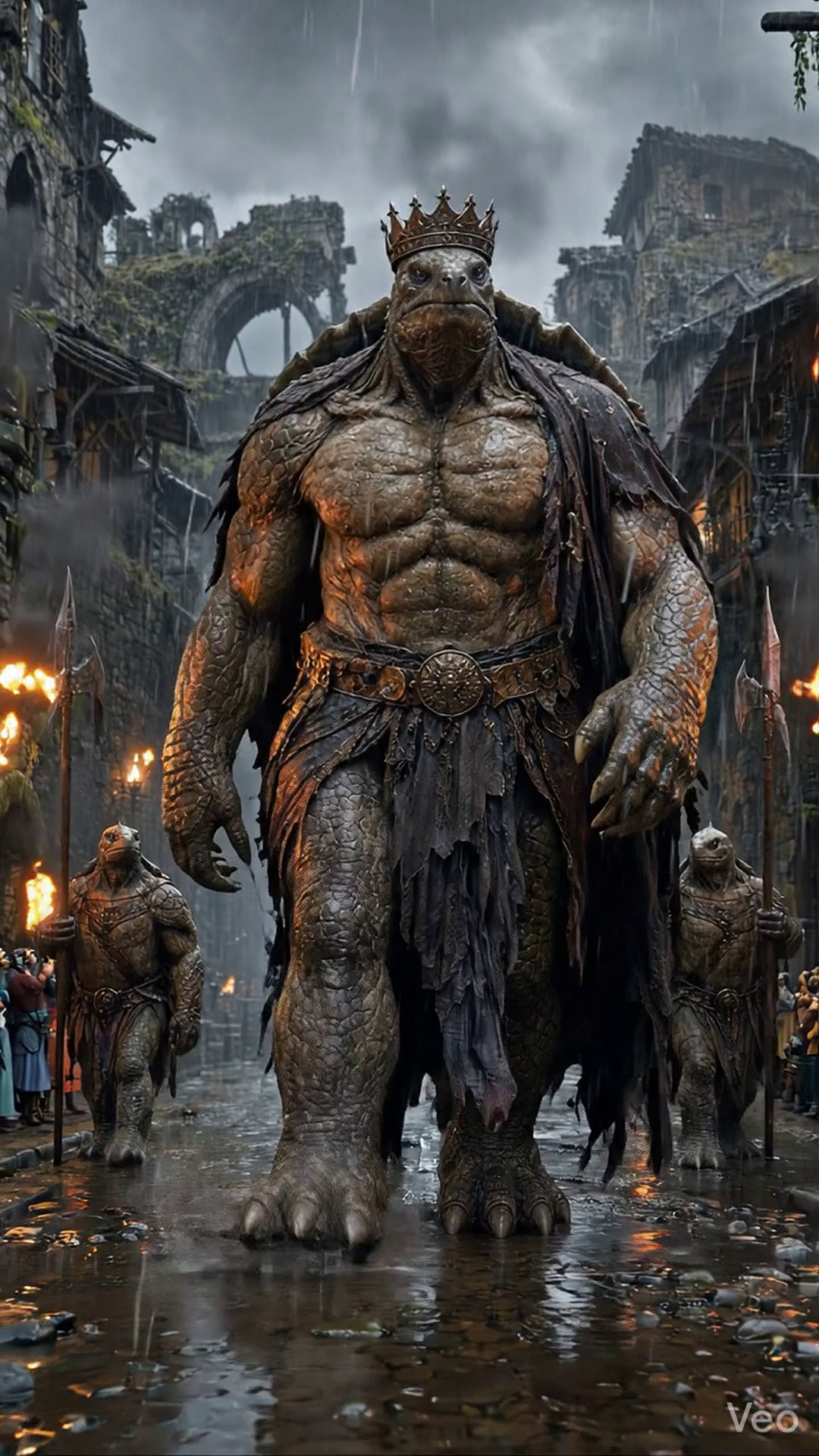
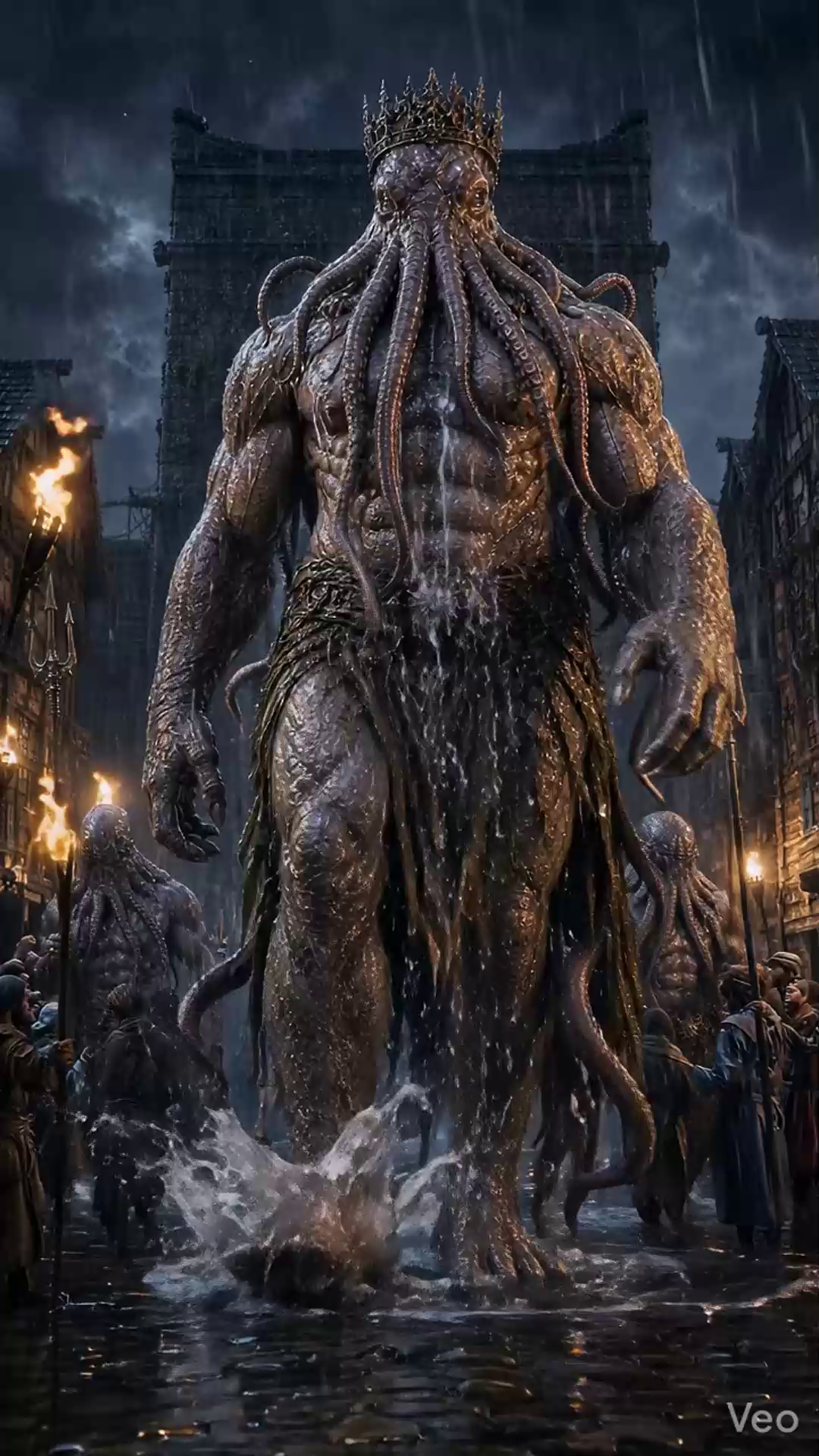
The doors were sealed for a reason. A banished leonine warrior came back scarred, exhausted, and silent. He did not knock. He pushed the royal chamber doors open with his own hands and entered the throne hall where his brother still sat above the red carpet. One brother wore the crown. The other had returned to claim what he believed was his.
This chapter is presented as a complete written tale with curated scene artwork from the realm archive.
The Lion Doors had not opened for seven years. They stood at the end of the western approach like a warning carved into wood and iron, taller than siege towers, wider than any gate in the old city, and beautiful enough to make even enemies lower their voices. Their dark panels were bound in black metal and covered in raised lion faces, curling vines, old battle sigils, and the names of kings who had believed their blood would never be questioned.
The guards posted before them did not speak when the ragged warrior arrived. They knew his shape before they knew his face: the breadth of his shoulders beneath torn armor, the ruined red cloak hanging from one side, the mane cut unevenly by weather, blades, and exile. The court had taught the younger soldiers that he was dead. The older soldiers had been taught something more useful. They had been taught never to say his name in the hall.
He stopped before the doors with his back to the world. Rainwater still clung to his armor from the road outside, though the palace corridor was warm with braziers. Scars crossed his arms and neck where gold once would have rested. The claws of his right hand flexed once, then closed. No horn announced him. No servant ran ahead. No petition was placed in his hand. He had not come as a supplicant, and everyone close enough to see him understood that immediately.
For a moment he only looked at the carvings. There, in the center of the left door, was the lion of the elder line, crowned and watchful. On the right was the lion of the younger line, jaws open as if mid-roar. As boys, he and his brother had been told that the two beasts guarded one kingdom together. Later, the court had explained that symbols were flexible things. Later still, the king had made the meaning simpler: one brother would sit the throne, and one brother would disappear.
The warrior placed both hands against the doors.
The first push did not open them. The chamber doors groaned deep inside their hinges, a sound like a buried ship shifting under stone. Dust fell from the carved lintel. A guard stepped forward by instinct, then stopped when the warrior lowered his head and drove his shoulder into the seam. Muscles tightened beneath fur and torn leather. Iron complained. Wood bent. Then the Lion Doors moved.
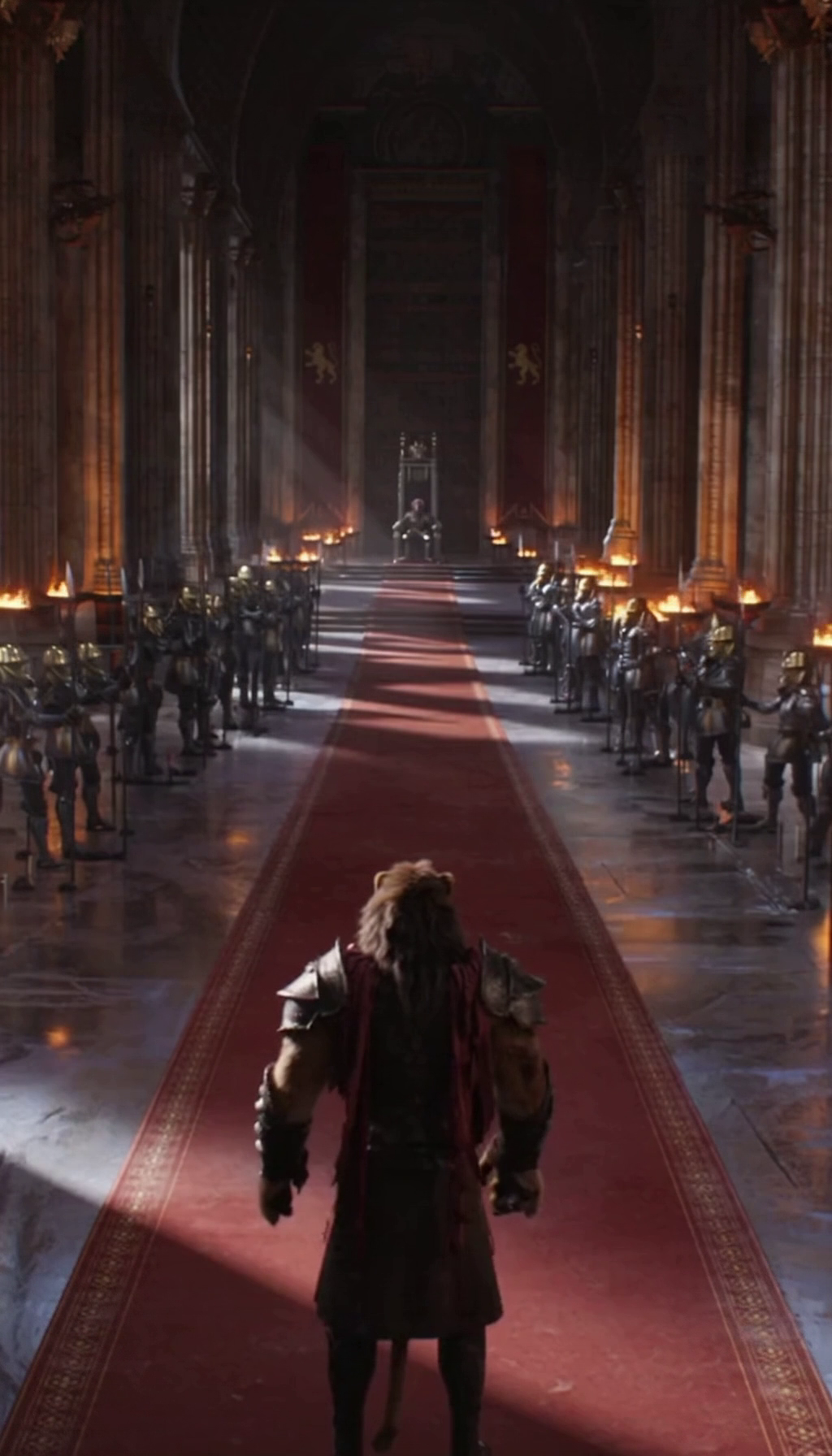
They swung inward slowly at first, then wider under the force of him. Firelight spilled through the opening. The throne hall beyond revealed itself in pieces: a red carpet running like a wound across polished stone, ranks of silent guards along the columns, banners hanging motionless in the hot air, braziers burning beneath statues of kings who had never imagined this moment.
At the far end of the hall, above the steps, the crowned brother sat on the stone throne.
He did not rise. That was the first cruelty. He remained seated in black armor worked with gold, a thin crown set across his mane, his face still enough to make anger look undisciplined by comparison. He had been younger once, quicker to laugh, quicker to follow his brother into places forbidden by tutors and priests. Now the throne had taught him the cold art of becoming furniture for power.
The warrior crossed the threshold fully. Behind him, the great doors remained open. No one dared close them. His boots touched the red carpet, and the sound moved down the hall in a chain of echoes. Every guard watched him, but none raised a spear. They had been ordered to stand silent. The king wanted no confusion about whose voice would decide the hour.
The banished brother stopped just inside the hall. He lifted his face toward the throne, and the scars across his muzzle caught the light. When he spoke, the words struck the columns and returned from the ceiling like thunder finding its way home.
"I have returned!"
The hall did not answer. It did not need to. The sentence had already done its damage. Men who had repeated court lies for seven years now stood in the presence of the fact those lies had failed to kill. The king looked down the long carpet at him, and something tightened beneath his calm.
The warrior walked forward. Step by step, he passed the braziers, the banners, the armored witnesses who remembered too much and would admit nothing. He kept his shoulders square to the throne. He did not turn toward the watching court. He did not look for allies among the guards. Exile had cured him of that particular weakness. If loyalty still lived in the room, it would have to reveal itself after he had already risked everything.
Halfway down the carpet, he stopped. The pause stretched until it felt almost ceremonial. Two brothers faced each other across the measured distance that kingdoms use to make blood look political.
Then the king spoke from the throne, his voice controlled, deep, and merciless.
"You were banished from this kingdom, brother."
The word brother did not soften the sentence. It sharpened it. Everyone heard what the king meant: not stranger, not traitor, not guest. Blood made the wound official. Blood made the exile personal. Blood made the challenge dangerous enough to stain every banner in the hall.
The warrior lowered his chin. For one breath, the scars and exhaustion seemed to weigh on him all at once. The roads beyond the border, the mercenary wars, the winter prisons, the years of hearing his own name turned into a lesson for obedient children. Then he lifted his eyes again, and whatever had nearly bent him burned away.
"I have come back to claim what is rightfully mine."
No sword was drawn. No guard moved. That restraint made the moment more terrible, not less. Fighting would have given the court an easier story. Violence could be condemned, contained, punished. A claim was harder. A claim walked through every law the king had written and asked who had given him the ink.
The brothers held each other in silence. Above them, the old lion faces carved into the doors watched from the far end of the hall. One door stood for the ruler who kept the crown. The other stood for the blood that had returned to take it back. Between them lay the red carpet, the guards, the throne, and the kingdom waiting to discover which brother history would call rightful.