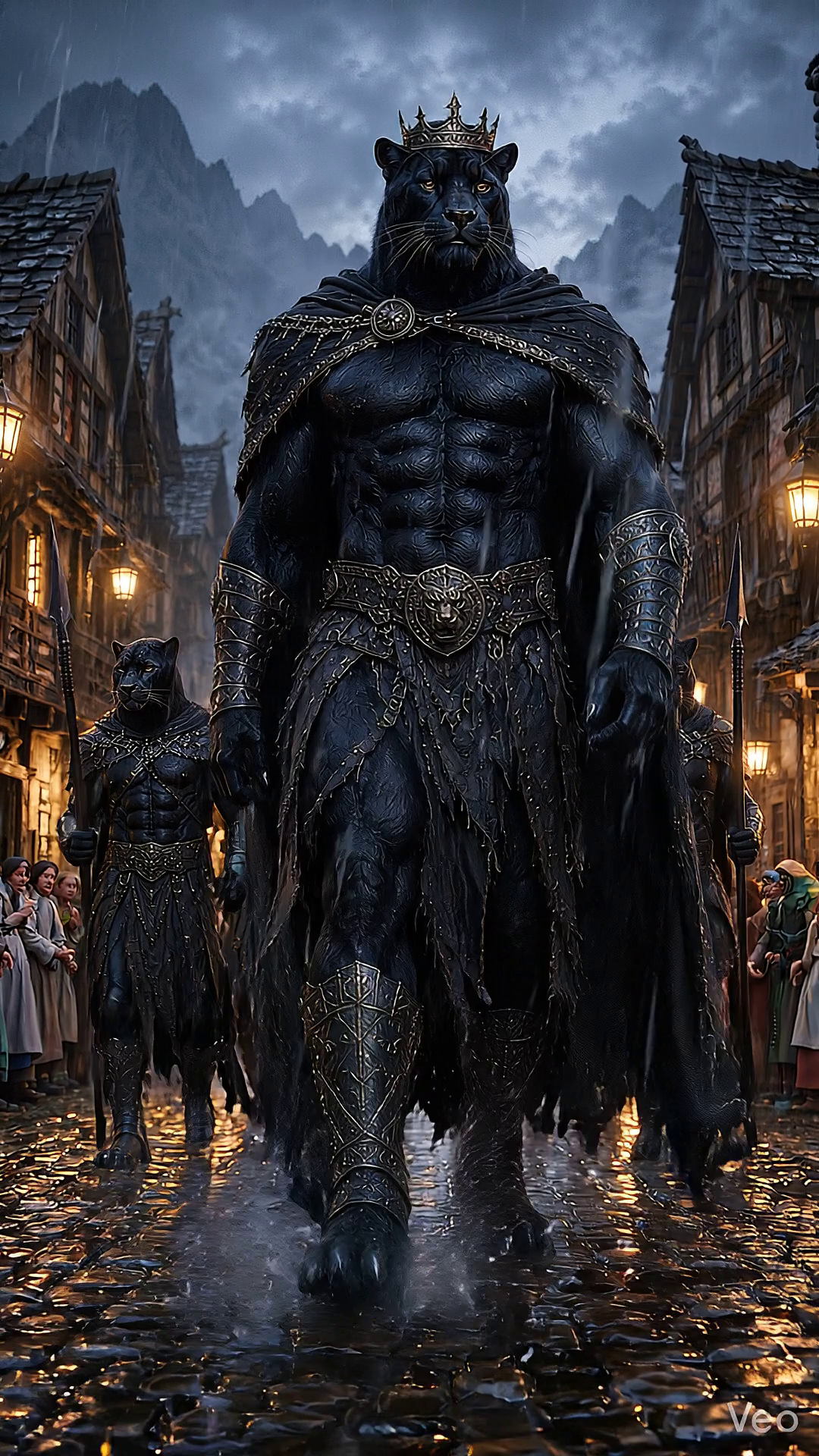
The Panther King did not announce himself. He walked into the mountain village with rain on his crown, two armed guards at his back, and enough silence to make every lantern seem afraid. No one blocked the road. No one asked why he had come. The village already knew what it had broken.
This chapter is presented as a complete written tale with curated scene artwork from the realm archive.
The mountain village of Veyr had been built in a place where sound traveled strangely. A dropped cup could be heard three alleys away, but a scream from the northern ravine might vanish before it reached the bell tower. The elders said the mountains decided what deserved to echo. The children believed them, because children believe anything that explains why adults go quiet at dusk.
For most of the year, Veyr was a narrow stack of timber houses, slate roofs, wet steps, and lanterns hung under crooked beams. Rain slid down the walls even when the sky looked clear. Mist came from the peaks and settled in the streets like an old debt. Traders liked the village because it guarded the pass between the eastern mines and the black pine road. They paid their tolls, slept under thick wool, and left before the fog became too dense to see the shrine stones.
The villagers liked to say the pass belonged to them. That was the lie prosperity had taught them.
Long before the roofs were raised, before the road was paved, before the first market bell rang, the pass had belonged to the Panther Crown. The first Panther King had opened it with claws, soldiers, and graves. His warriors cleared the avalanche paths, hunted the raiders who lived in the ravines, and stood watch through winters so cold that spear shafts split in armored hands. In return, Veyr was allowed to exist. The village swore an oath in iron, salt, and lamplight: the pass would never be closed to the crown, and every seventh winter the village would send its tribute of metal, grain, and service.
The seventh winter came and went. No tribute left Veyr.
The council blamed the mines at first. Then the river road. Then a sickness among the pack animals. Each excuse was wrapped in respectful language and sent down the mountain with enough coin to make the messenger brave. When no answer came back from the Panther Crown, the council mistook silence for weakness. They ordered the old black standard removed from the gatehouse. They locked the tribute hall. They told the younger villagers that the Panther King was a story invented to frighten merchants into paying extra tolls.
But there are silences that mean absence, and there are silences that mean approach.
On the evening the Panther King arrived, rain had polished the road until every lantern doubled itself in the stones. The market was closing. Bakers were pulling shutters across their windows. A boy near the well was dragging a basket of turnips home when he saw the guards first: two dark figures moving out of the fog with spearheads bright enough to catch the last blue light of the mountains.
The boy dropped the basket. This time, the sound echoed everywhere.
Doors opened. Then doors stayed open. The villagers watched as the two guards emerged fully into the street, panther-headed, armored in black metal, smaller than the figure behind them and therefore still frightening in the ordinary way soldiers are frightening. Each held a long spear upright. The weapons did not waver. Rain ran down the blades and gathered at their points before falling onto the cobblestones.
Then the Panther King stepped into Veyr.
He was taller than the inn sign, broader than the shrine doors, and so still in the face that for a moment he seemed less like a living ruler than a statue the mountain had sent down to correct a memory. A dark crown rested above his ears. His black fur carried the rain in silver beads. A heavy cloak hung from his shoulders, torn at the edges, moving behind him like a piece of night that had learned obedience. Beneath it, his chest and arms were bare, massive, and marked by old scars that caught the lantern glow in thin pale lines.
No herald walked before him. No horn sounded. He did not need announcement. The street emptied ahead of him as if the stones themselves had warned the people to step aside.
Councilwoman Mara reached the market square just as he passed the fountain. She had argued hardest against sending tribute. She had said the village had grown beyond old arrangements. She had said crowns far away had no claim on hands that worked here, roofs that leaked here, graves dug here. Those words had sounded almost noble inside the council chamber. In the rain, with the Panther King walking toward her, they sounded like something a person says before learning the price of being wrong.
She bowed because everyone was watching. The bow came late enough to be noticed and deep enough to be an apology without becoming one.
The Panther King stopped in front of her. His guards stopped behind him, one to the left and one to the right, spears still upright. The whole village seemed to hold its breath around the three of them. Rain tapped on shingles. Water slid from the fountain lip. Somewhere, a shutter banged once and then was caught by nervous hands.
Mara began with explanations. The mine yields had fallen. The winter stores were thin. The eastern road had become unsafe. The tribute hall had been locked only for safekeeping. The black standard had been removed only because the cloth had rotted. Each sentence died a little sooner than the last. The Panther King listened without interrupting, which made the excuses feel smaller than if he had roared over them.
When she finished, he looked past her to the empty gatehouse where his crown standard should have hung. That was when the villagers understood he had not come for grain first, or metal, or service. He had come for the truth of the oath. Tribute could be counted later. Disrespect had already been measured.
His voice, when it came, was low enough that people felt it in the wet wood of the doors behind them. He told Veyr that hunger could have been forgiven. Poverty could have been answered. A request for mercy would have reached the crown and returned with guards, wagons, and winter stores. But the village had chosen to erase the hand that kept the pass open and call that erasure freedom.
No one looked at Mara then. That was its own verdict.
The Panther King gave no order for chains. He drew no blade. His guards did not move. Instead, he named the terms of repair. The black standard would be raised before midnight. The tribute hall would be opened in front of every family in Veyr. The unpaid winter debt would not be taken in food while children were hungry, but in labor along the pass: bridge beams replaced, watchfires restored, avalanche walls rebuilt, and three months of guard service from every council house that had signed the refusal.
Mara swallowed rain and pride together. She asked what would happen if the village refused again.
The Panther King looked down the road he had entered by. The mist had thickened behind him until the pass was invisible. Only the spearheads of his guards caught the light.
He said the mountain would remember who had been protected and who had mistaken protection for ownership.
After that, the village moved quickly. Men climbed the gatehouse with wet ropes. Women unlocked the tribute hall and carried out the old iron-bound ledgers. Children watched from doorways as the black standard was lifted into the rain. When it opened in the wind, the panther mark appeared darker than the night behind it.
The Panther King did not smile. He did not accept praise. He stood in the center of the road while Veyr corrected itself around him. His guards remained behind him with their spears upright, silent as judgment. By morning, the pass would belong to the crown again in the only way that mattered: not because the king had shouted, but because he had arrived.
Years later, travelers would still ask why the village lowered its voice at dusk. The elders would point toward the northern road, where rain always seemed to gather first, and say the mountains decided what deserved to echo. Then they would add one more lesson, spoken softly enough that children leaned closer to hear it.
When the Panther King walks into your village, it is already too late to pretend you forgot his name.