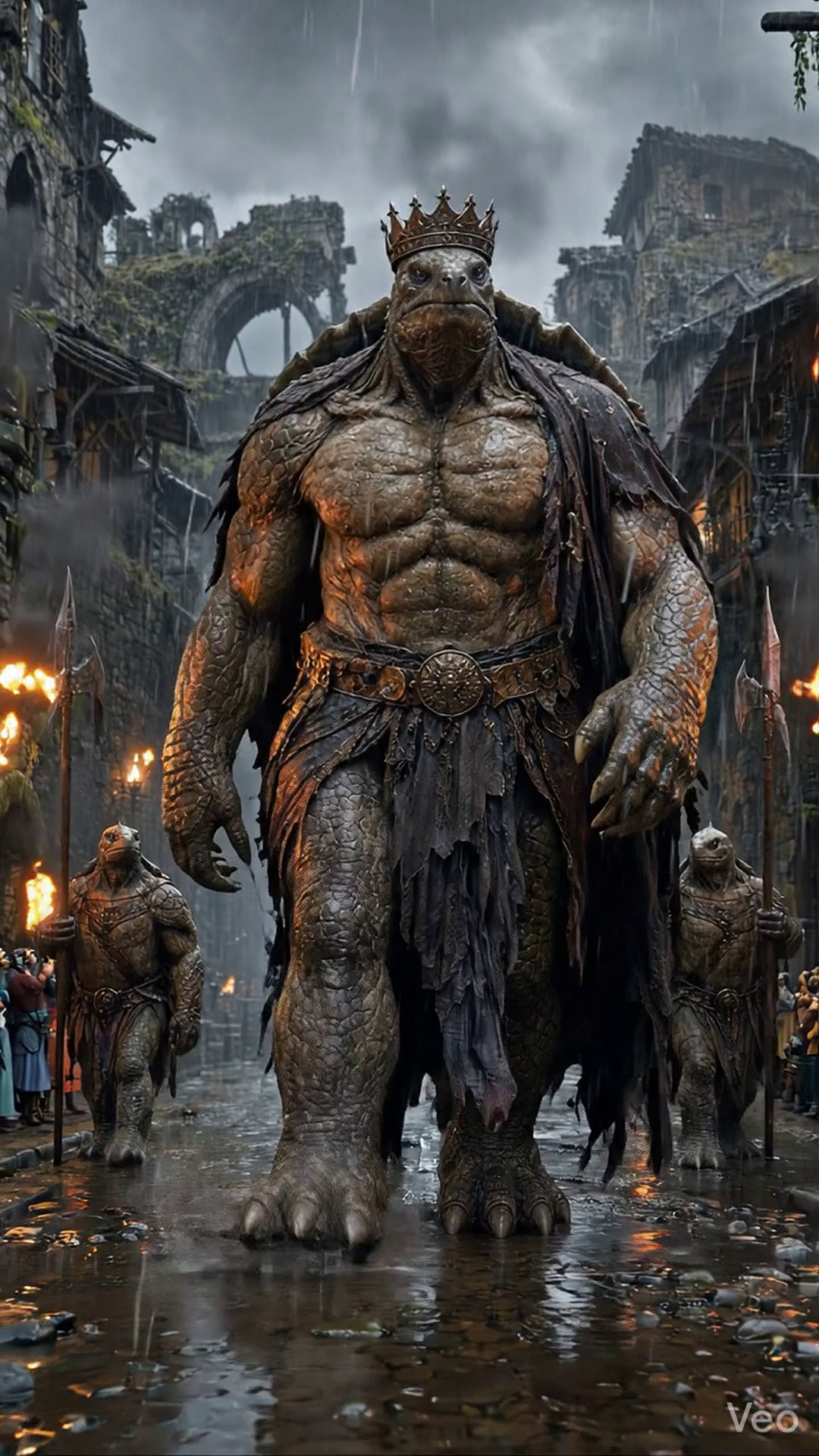
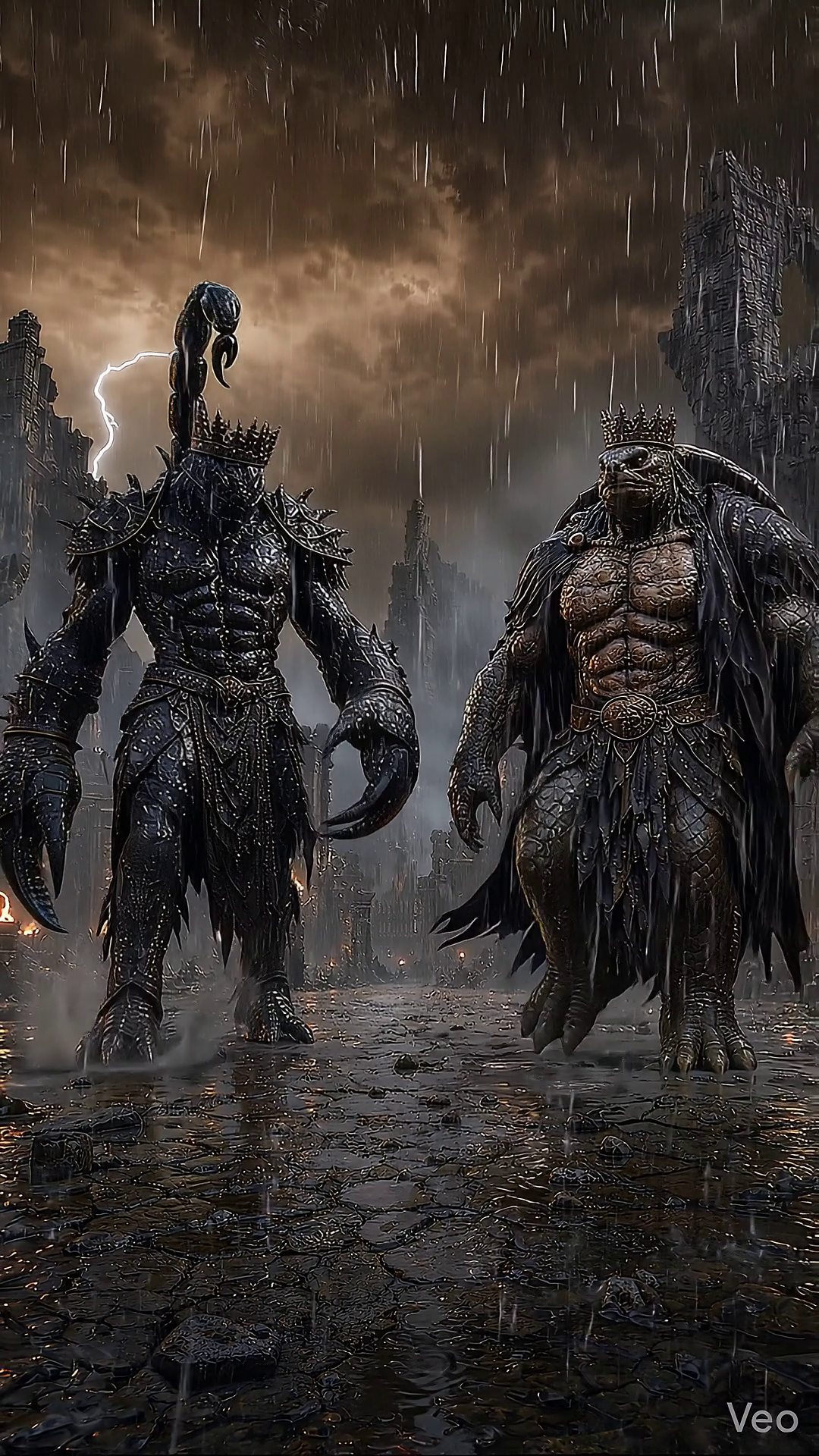
The storm opened a road between two kingdoms. On one side, the Scorpion King crossed the wet stones with his tail raised above the rain. On the other, the Turtle King came forward beneath the weight of his shell and crown. No guards. No army in the frame. No speech. Just two rulers closing the distance while the old ruins waited to learn which crown would refuse to turn back.
The road between Karath and Velmire had once been a trade route. Salt from the western shelves crossed it in gray sacks. River copper from the marsh villages crossed it in hammered bars. Pilgrims used it when the old shrines still had roofs, and merchants told their children that any ruler who controlled that road controlled the argument between desert and flood.
By the time the Scorpion King and the Turtle King came to it, the road had lost its innocent name. People called it the Drowned Causeway because the stones never dried anymore. Rain fell there even when the hills were clear. It collected in the cracks, filled the old chariot ruts, and turned every torch into a trembling reflection. Ruined arches leaned over the path like witnesses too tired to speak.
The quarrel had begun with a small thing, as dangerous quarrels often do. A caravan bearing the Turtle King's shell mark had vanished beyond the fifth western column. The wagons were found split open, the grain spoiled, the water skins cut, and three royal escorts lying in the mud with black stinger marks carved into their shields. The message was clear enough for frightened men. It was also too clear for patient ones.
The Turtle King did not answer at first. His court expected anger, but turtle law moves slowly because it is built to survive storms. He sent surveyors to the broken road. He sent two quiet clerks to count the wheel tracks. He sent a river priest to ask whether any body had been moved before burial. Each report returned with the same uneasy pattern: the attack looked like the work of the Scorpion King's raiders, except in all the places where real raiders would have been careless.
In the west, the Scorpion King received a different wound. Three scorpion scouts were found dead beside a flooded tollhouse, each with a green river coin pressed into the mouth. The younger captains demanded retaliation before sunset. They said the Turtle King had grown old behind village walls and believed patience was the same as weakness. They said a crown that did not strike after such an insult would invite every small kingdom to test its shell.
The Scorpion King listened beneath the black banners of Karath. Rain tapped the copper roof above his throne. His tail curved slowly behind him, not in threat, but in thought. He knew the language of arranged evidence. He had used it once, long ago, before age and consequence made cleverness taste less sweet. Still, knowing a trap exists does not always reveal where the door is. A ruler who refuses every insult may preserve wisdom and lose the fear that keeps his borders standing.
So both kings moved. Not with armies at first. Armies are loud, and this question had become too dangerous for noise. The Turtle King left Velmire with no procession, only the storm-dark cloak over his shoulders and the old bronze crown that river villages bowed to even when they cursed his taxes. The Scorpion King descended from Karath without his court, his black chitin shining under rain, his massive pincers low, his tail raised like a question no scribe could soften.
They chose the Drowned Causeway because neither kingdom fully owned it. That made it honest. The broken towers belonged to a dead dynasty. The stones belonged to weather. The puddles reflected whichever crown stood nearest and forgot both a moment later. If one king turned back there, everyone would know. If one king struck first, everyone would know that too.
At the western end of the causeway, the Scorpion King stepped through mist and torch smoke. Each footfall sent water outward in hard silver rings. He was taller than the ruined gate beside him, crowned in wet gold, plated in black armor that was not armor at all but the living shell of his body. His pincers opened and closed once, slowly, then settled. He had come prepared for violence, but he had not come hungry for it.
At the eastern end, the Turtle King entered the road with the dreadful calm of a landslide deciding where to fall. His shell rose behind him like a moving fortress. Rain ran over the ridges of his shoulders and down the scars across his chest. He carried no spear. He needed none to remind the world of weight. Villages had opened their gates for less than the sound of his footsteps in a storm.
For a long breath, they were only shapes across the distance. Black chitin on the left. Old scaled bronze on the right. Between them lay the empty road, wide enough for pride to survive if either ruler chose to leave. Neither did. The Scorpion King began walking first, not quickly, not theatrically, but with the deliberate pace of a ruler who understands that every step becomes law once people hear about it. The Turtle King answered with one heavy step of his own.
Rain made the scene almost silent. Thunder covered whatever words might have risen in either throat. Perhaps that was mercy. Courts ruin dangerous moments by filling them with arguments, witnesses, interpretations, and names for cowardice. Here there was only movement. Tail and shell. Crown and crown. The old causeway shortening beneath two rulers who had both been given enough grief to start a war and enough doubt to fear who wanted that war started.
As they closed the distance, both kings saw what messengers had failed to carry. The Scorpion King saw the Turtle King's face was not the face of a ruler proud of ambush. The Turtle King saw the Scorpion King's pincers remained low, not lifted for the first strike. That did not make either innocent. Kings are rarely innocent. But it made the story less simple than the dead scouts, the cut water skins, the coins, and the carved shields had wanted it to be.
They stopped close enough for rain to fall from one crown onto the wet stones between them. The Scorpion King could have struck. The Turtle King could have crushed him before the tail came down. Instead they held the moment where every war either begins or loses its excuse. Neither bowed. Neither smiled. Neither offered peace like a gift. They simply looked at each other long enough to understand that someone absent had arranged for them to meet as enemies.
The first words were never sung properly afterward. Songs prefer threats, and the words were not a threat. The Turtle King asked who had taught the western killers to mark a shield so neatly. The Scorpion King asked who had taught river men to leave coins where only fools would believe them. It was not friendship. It was not forgiveness. It was the beginning of suspicion pointed in a more useful direction.
Behind the ruined gates, spies waiting for blood saw no blow fall. That frightened them more than battle would have. Battle can be predicted. Two angry kings thinking at the same time can ruin an entire conspiracy. By dawn, riders would leave in opposite directions carrying orders that sounded like restraint but moved like blades: find the wagon tracks that turn north, find the smith who made the false stingers, find the priest who buried the wrong bodies, find the hand that wanted desert and flood to spend themselves against each other.
The Drowned Causeway did not become peaceful after that night. Roads remember too many feet for easy peace. But the stones remembered something rarer than victory. They remembered two rulers who had been given every reason to strike and still walked close enough to see the trap reflected in each other's eyes. Sometimes a kingdom is saved not by the king who wins the first blow, but by the one who stops just before it and asks who placed the weapon in his hand.